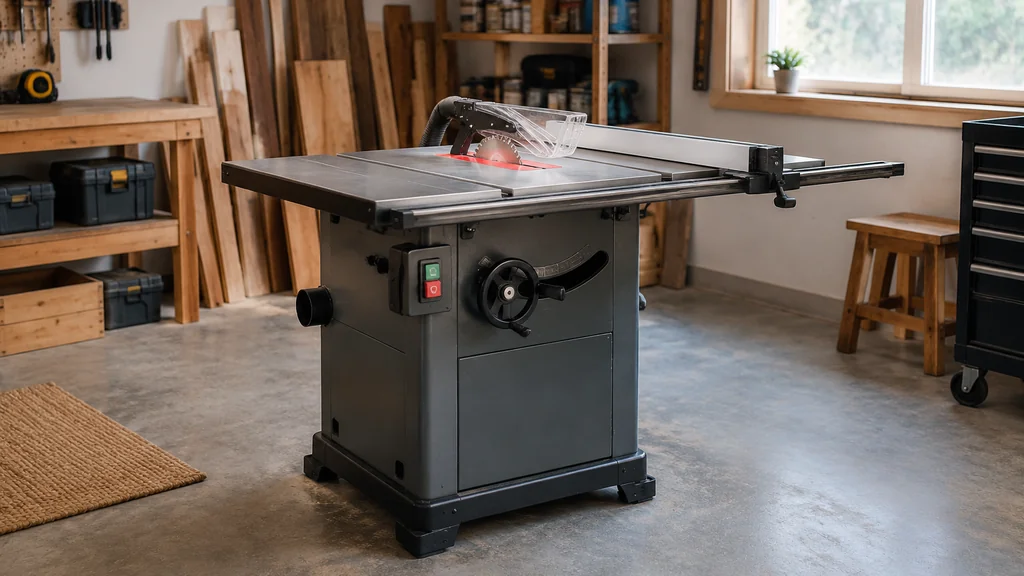
A table saw is the one machine that decides how accurate every other cut in your shop will be. Contractor saws are light, cheap and portable; hybrid saws split the difference with a full cabinet-style trunnion on a lighter frame; cabinet saws are heavy, quiet and built to stay in one spot for twenty years. Buy the fence and the mass first, the motor second.
Start With Where the Saw Will Live
Measure the floor before you read a single spec sheet. A full-size table saw needs infeed and outfeed clearance roughly equal to the length of the longest board you plan to cut, plus room to walk around the back of the blade. In a one-car garage that footprint is often the deciding factor on its own.
Three real constraints drive the choice:
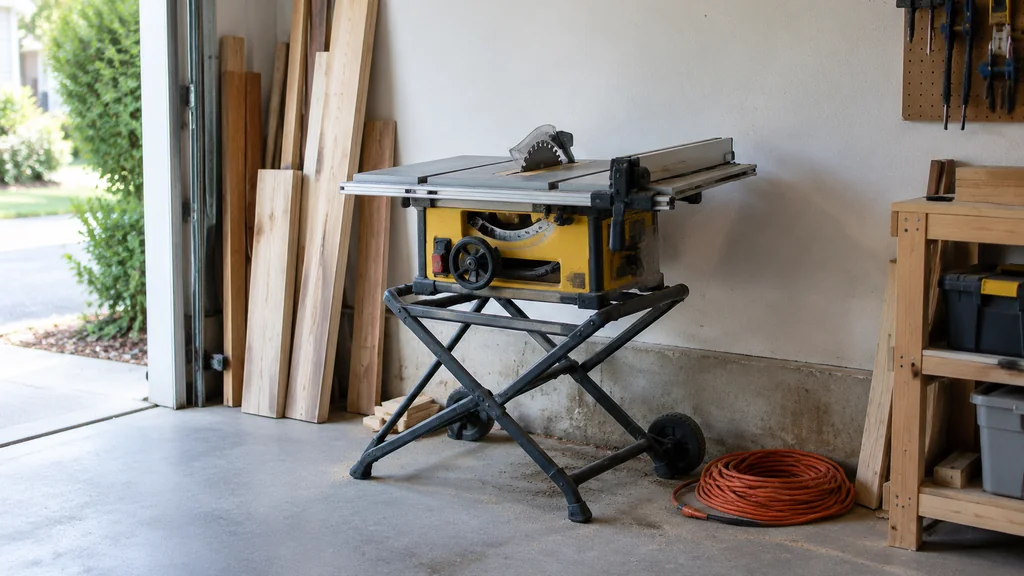
- Space. A cabinet saw wants a permanent home. A contractor saw folds onto a stand and leans against the wall.
- Power. Most garages and basements run on a standard household circuit. Big cabinet saws often want a dedicated circuit, and that is an electrician’s job, not a weekend one.
- Noise and vibration. Mass absorbs vibration. A heavy cast-iron top and a closed cabinet cut both the shake and the racket.
If your shop shares a wall with a bedroom, that last point matters more than you think.
The Three Classes, Honestly Compared
Contractor saws. A motor hanging off the back, a sheet-metal or stamped-steel top, and a stand. They are the cheapest way into a real 10-inch blade, and they cut accurately if you set them up carefully. The weak points are the fence and the trunnion assembly, which is the casting that holds the blade arbor and lets you tilt it. On budget models that casting flexes, and a flexing trunnion means the blade drifts out of alignment under load.
Hybrid saws. A hybrid puts the trunnion inside a closed cabinet like a cabinet saw, but keeps a lighter top and a smaller motor so it can still run on a standard circuit. For most home shops this is the sweet spot. You get the better dust path and the stiffer blade carriage without rewiring the garage.
Cabinet saws. A full cast-iron top, a big induction motor, a heavy cabinet and a fence that stays where you put it. These are the saws that hold tolerance year after year. They are also the saws you buy once. If you plan to build cabinets, doors or furniture for the next decade, this is the class that stops you from upgrading twice.
The Fence Is Half the Saw
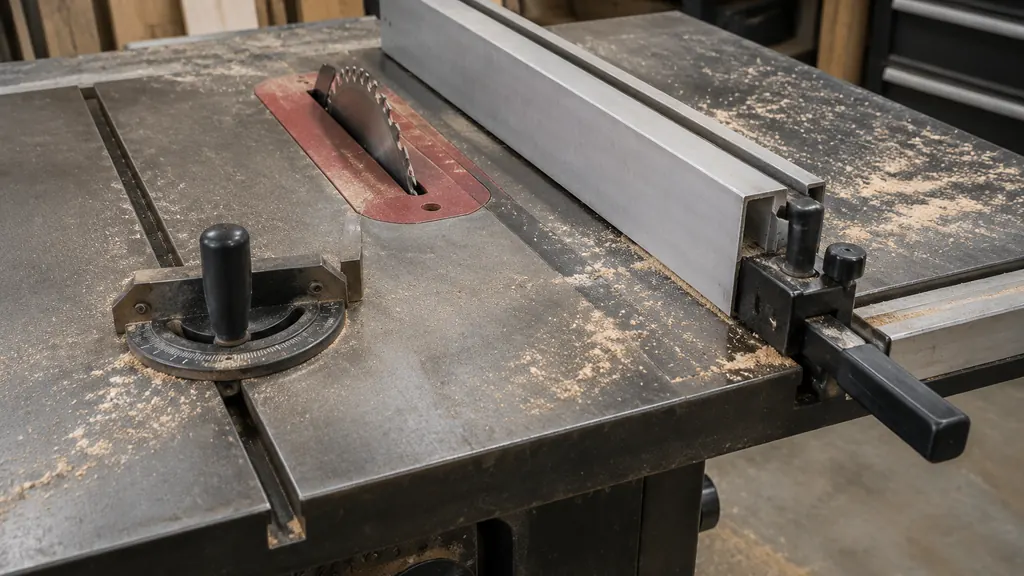
You can live with a modest motor. You cannot live with a fence that moves when you lean on it. A fence that drifts a hair between the front and back of the blade will give you a board that binds, and a binding board is how kickback starts.
Check three things on any saw you are considering:
- Does the fence lock at both the front and the rear, or only at the front?
- Does the fence ride on a solid steel or aluminum extrusion, or on a folded sheet-metal rail?
- Can you adjust it square to the miter slot, and does it stay there after a week of use?
A quality aftermarket fence can transform a mid-range saw, and it costs far less than moving up a whole class. Budget for it if the stock fence feels flimsy in the showroom.
While you are thinking about hardware that has to hold under load, the same logic applies to the fasteners you drive into a wall. Undersized anchors fail the same way a weak fence does, quietly and at the worst moment. Our notes on screwing into drywall anchors cover depth and pull-out the way a fence discussion covers drift.
Motor, Blade and the Cut You Actually Make
Blade size is settled for you. Ten inches is the home-shop standard, and the tooling ecosystem around it is enormous. What varies is how much torque the motor delivers and how the saw handles a thick rip.
- Direct-drive versus belt-drive. Belt-drive saws run smoother and are easier to service. Direct-drive motors are compact but transmit more vibration to the work.
- Induction versus universal motor. An induction motor hums. A universal motor screams. Your neighbours will notice the difference.
- Rip capacity. This is set by the distance from the blade to the fence at full extension. Check the spec sheet rather than guessing, because two saws with the same blade can differ by several inches of rip.
Blade choice matters as much as the machine. A dedicated rip blade with a flat-top grind clears chips fast and pulls less power. A general-purpose combination blade leaves a finer crosscut but loads the motor harder in thick hardwood. Keep both, and change them instead of forcing one blade to do everything.
Sharpening and setup tools are not optional extras. A dial indicator and a good square let you align the blade to the miter slot, which is the single adjustment that most affects cut quality. Do that once properly and a mid-priced saw will out-cut a badly set-up expensive one.
Dust, Safety and the Parts Nobody Talks About
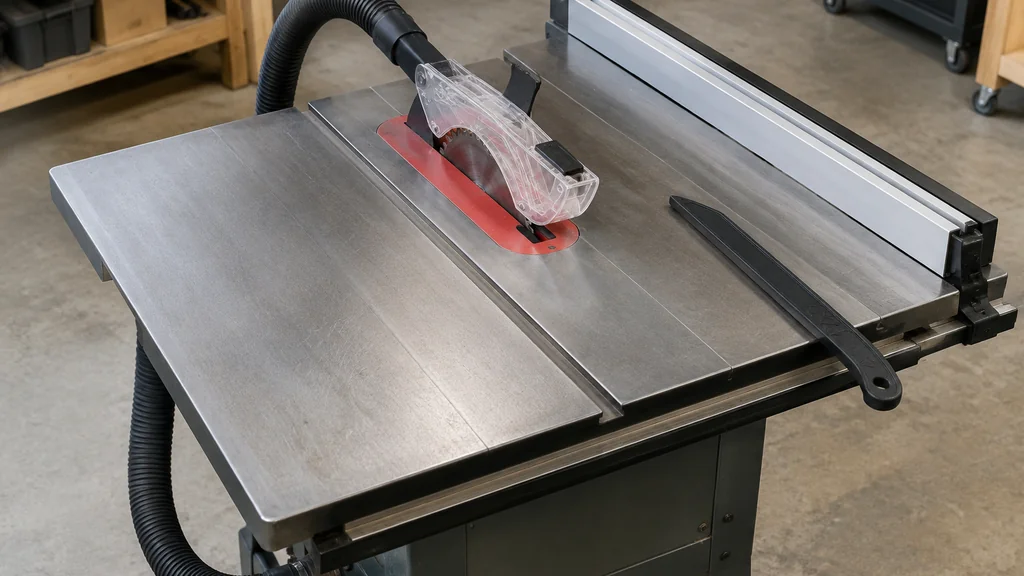
Dust collection on a table saw is a real design difference between the classes. A contractor saw with an open base throws dust out the back and into the air. A hybrid or cabinet saw with a closed base and a collection port captures most of it at the source. If you cut MDF or pressure-treated stock, that difference is a health issue, not a convenience one.
Safety gear is not negotiable, and it is the same on every class of saw:
- A riving knife that rises and falls with the blade helps reduce kickback.
- A blade guard you actually leave on for through-cuts.
- Push sticks and a push block, kept within arm’s reach, not in a drawer.
- Eye and hearing protection, every cut, no exceptions.
Keep the blade guard installed for through-cuts. A hand over a spinning blade can cause a serious injury.
One more shop habit is worth building. Keep your cutting tools sharp and your drilling tools sharper. A dull bit makes you push harder, and pushing harder on a drill press or a hand drill is how work spins and hands get cut. Our piece on Forstner bits versus spade bits explains when each one earns its place, which matters once you start drilling the dog holes and jigs that go with a new saw.
What It Costs to Own One
Prices move, so treat any number you see online as a starting point and check current listings. What does not move is the shape of the spending.
- Contractor saw: lowest entry cost, but budget for a better fence, a mobile base and a decent blade.
- Hybrid saw: mid-range price, and usually the best value per dollar for a home shop that cuts every weekend.
- Cabinet saw: highest price, plus a possible electrician visit, a heavier mobile base and more floor space.
Add the hidden line items either way. A quality blade, a dado stack if you plan to cut joinery, a crosscut sled you build yourself, and dust hose and fittings. Those extras can add a meaningful percentage to the saw’s sticker price, and skipping them means the saw underperforms on day one.
If you are running cordless tools alongside the saw, battery care affects how long a day you can work. Our guide to lithium-ion tool batteries covers charging and storage habits that keep packs alive through a long build.
When to Call a Pro
Consult a qualified electrician about a cabinet saw that needs a dedicated circuit, especially in an older house with wiring that has been added to over the decades. Do the same before making any change to a panel to free up capacity. Check local requirements, and do not tap into an existing circuit because it happens to have a spare breaker.
Assembly, alignment, fence tuning, building a crosscut sled and setting up dust collection are covered in the manual. Follow its instructions, and get qualified help if you are unsure about any part of the setup.
Table Saw FAQ
Which type is best for a beginner?
A hybrid saw suits most beginners who have a fixed spot in a garage or basement. It gives you a stable blade carriage and decent dust collection without demanding a dedicated circuit or a permanent footprint. A contractor saw is fine if you must move it constantly.
Can I run a cabinet saw on a normal household outlet?
Many cabinet saws draw more current than a shared household circuit can supply, and some need a specific voltage. Check the motor nameplate and the spec sheet, then have a licensed electrician confirm what your panel can support. Do not assume a spare breaker means spare capacity.
How much rip capacity do I really need?
It depends on what you build. If you break down sheet goods, you want enough capacity to rip a panel in half, which usually means a wider fence rail and outfeed support. Check the spec sheet for the exact figure.
Do I need a dado stack?
Only if you plan to cut grooves, rabbets and joinery on the saw. A dado stack adds cost and setup time, and it removes the riving knife on most saws, so many woodworkers cut those joints with a router instead. Decide based on the work you actually do.
Is a used cabinet saw a better buy than a new hybrid?
Often yes, if the trunnion and fence are sound and the motor runs smoothly under load. Inspect the cast-iron top for rust pitting, check the fence for play, and listen for bearing noise. A well-kept older cabinet saw can outlast two new budget machines.
Thank you for reading!