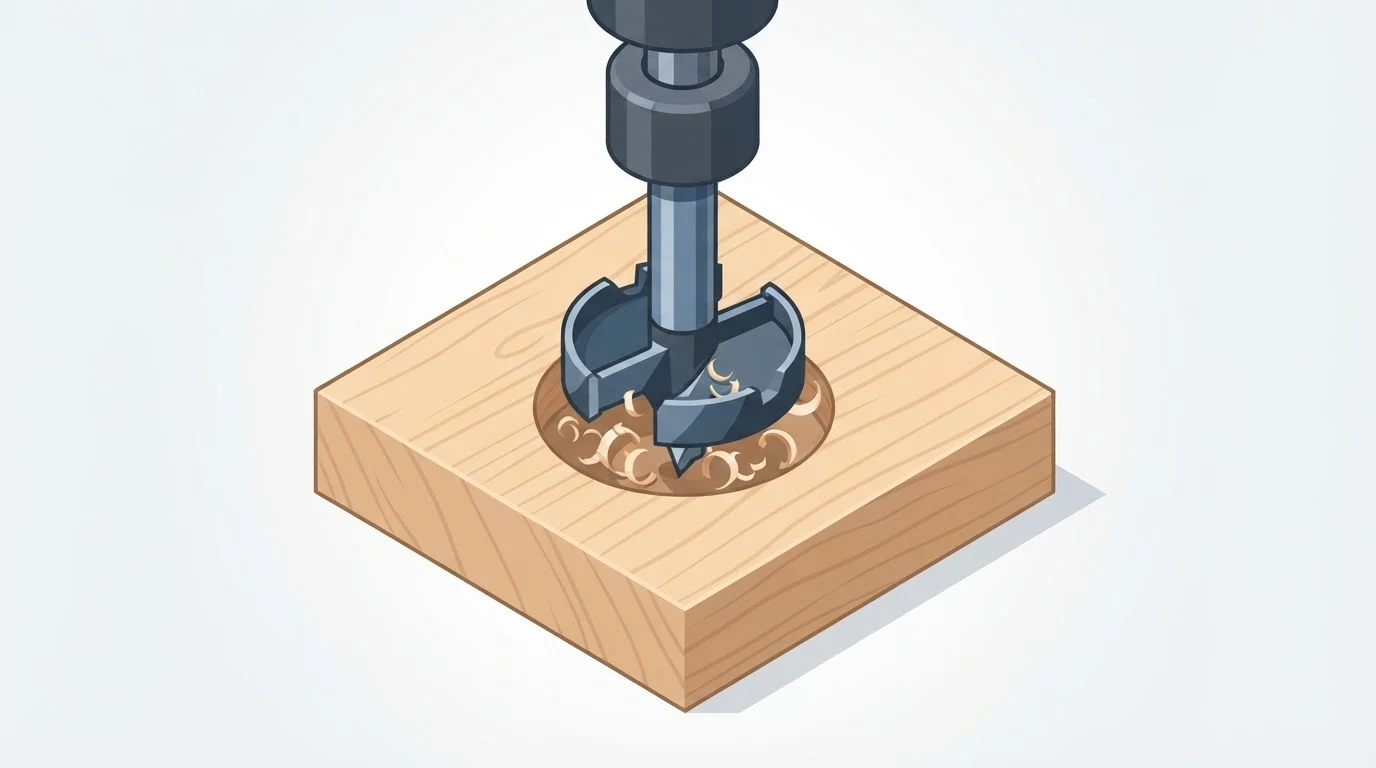
A quality Forstner bit is the right tool when you need a flat-bottomed hole with clean, chip-free edges. A spade bit is faster and cheaper, but it wanders, tears the exit side, and leaves a pointed bottom. If you are drilling hinge mortises, shelf-pin holes, dowel joints, or counterbores for plugs, a Forstner bit earns the extra cost and setup time. For rough framing or holes that will be hidden, a spade bit still wins.
What Is a Forstner Bit?
A Forstner bit is a drill bit designed to cut a flat-bottomed hole with a clean, smooth rim. It has a circular rim with sharp cutting edges and a small centering spur in the middle. Unlike a spade bit, which has a flat paddle shape, a Forstner bit cuts with its outer rim, scoring the wood fibers before the center spur pulls the bit through. This action prevents tearout on the entry side and, with a backing board, on the exit side too.
Forstner bits are available in high-speed steel (HSS) and carbide-tipped versions. Carbide costs more but holds an edge longer in hardwood and engineered materials like plywood and MDF. HSS is fine for softwood and occasional use. The bits come in diameters from about a quarter inch up to two inches or more, with a standard hex or round shank that fits a hand drill or drill press chuck.
- Rim
- The circular cutting edge around the outside of the bit that scores and shears the wood fibers to define the hole’s edge.
- Centering spur
- The small point in the middle of the bit that keeps it from wandering off the marked center as the rim cuts.
- HSS (high-speed steel)
- The standard, cheaper bit material — holds up fine for softwood and occasional use.
- Carbide-tipped
- A bit with a harder cutting edge brazed onto the rim, holding its edge longer in hardwood and engineered panels like plywood and MDF.
How a Forstner Bit Works
The bit’s outer rim cuts a circle into the wood surface. The centering spur keeps the bit from wandering as the rim deepens the cut. As the bit spins, the rim shears the wood fibers, and the spur pulls the bit straight down. The result is a hole with a flat bottom and clean, sharp edges, even in end grain.
Because the cutting action is concentrated on the rim, the bit generates more heat than a spade bit. You need to run it at a slow speed. Use the lowest setting on a hand drill, or roughly 250 to 750 RPM on a drill press for larger bits. Steady, firm pressure is better than forcing it. Back the bit out occasionally to clear chips.

Forstner Bit vs Spade Bit vs Brad Point
These three bits solve the same problem in different ways, and the hole they leave behind tells you which one was used. Hole shape, edge cleanliness, drilling speed, and price are what actually separate them.
| Feature | Forstner Bit | Spade Bit | Brad Point Bit |
|---|---|---|---|
| Hole bottom | Flat | Pointed (V-shaped) | Pointed (conical) |
| Edge cleanliness | Very clean, minimal tearout | Moderate tearout, especially on exit | Clean entry, some tearout on exit |
| Speed to drill | Slow (requires low RPM) | Fast (high RPM) | Moderate |
| Typical use | Hinge mortises, shelf pins, dowels, counterbores | Rough framing, electrical, plumbing | Dowel joints, precise centering |
| Price tier | Mid to premium | Budget | Budget to mid |
A brad point bit has a sharp center point that prevents wandering and cuts a clean entry hole, but it leaves a pointed bottom and can still blow out the back. A spade bit is the cheapest and fastest, but it wanders off center and tears the exit side badly. A Forstner bit is the most precise and cleanest, but it is slower and costs more.
When to Use a Forstner Bit Instead of a Spade Bit
Reach for a Forstner bit when the hole’s bottom or edges matter — it beats a spade bit on these jobs every time:
Hinge mortises. A standard cabinet hinge requires a flat-bottomed recess for the hinge cup. A Forstner bit cuts that recess cleanly. A spade bit leaves a pointed bottom that will rock the hinge and ruin the fit.
Shelf-pin holes. Those rows of holes in cabinet sides need to be straight and evenly spaced. A Forstner bit cuts a clean, flat-bottomed hole. A spade bit wanders and leaves a V-shaped hole. For shelf pins, a brad point bit is the typical choice, but a Forstner bit also works well.
Dowel joints. For a strong dowel joint, the hole must be perpendicular to the surface and have a flat bottom so the dowel seats square and evenly. A Forstner bit does that. A brad point bit is also good here, but a spade bit is too inaccurate.
Counterbores for plugs. When you sink a screw below the surface and cover it with a wood plug, the counterbore needs a flat bottom. A Forstner bit cuts that flat recess. A spade bit leaves a cone shape that the plug won’t sit flush in.
Drilling into end grain. The rim of a Forstner bit cuts cleanly across end grain without splintering. A spade bit tends to catch and tear.
When a Spade Bit Still Wins
A spade bit is not useless. Keep one in your bag for these situations:
Rough framing and construction. If you are drilling through studs for wiring or plumbing, nobody cares about the hole’s bottom or edge. A spade bit is fast, cheap, and easy to sharpen with a file.
Holes that will be hidden. If the hole is inside a wall, under a floor, or behind a cabinet, use a spade bit and save time.
Quick, one-off holes. If you need a single hole in softwood and you don’t have a Forstner bit handy, a spade bit will get the job done. Just clamp a backing board behind the workpiece to reduce tearout.
How to Use a Forstner Bit Without Tearout
Tearout on the exit side is the main complaint with any drill bit. For a Forstner bit, the fix is a backing board.
Clamp a scrap piece of wood (plywood, MDF, or solid wood) behind the workpiece. The bit will drill through the workpiece and into the scrap, and the scrap will support the wood fibers so they don’t blow out. Use a sturdy backing board that is firmly clamped in place.

For precision drilling tasks like hinge mortises, where a specific depth is critical, use a depth stop or wrap tape around the bit as a visual guide. This prevents drilling too deep while the backing board prevents exit tearout.
A backing board costs you nothing but a scrap of plywood and thirty seconds of clamping. Skipping it costs you a blown-out workpiece.
Buying a Forstner Bit Set
The average homeowner does not need a full set of 30 bits. A set covering a quarter inch to two inches in diameter handles most jobs, including hinges, shelf pins, dowels, and plugs. Look for a set with a storage case to keep the bits organized and protected.

Choose between HSS and carbide-tipped. For occasional drilling in softwood, HSS works well and costs less. Carbide-tipped holds an edge longer in hardwood and plywood, and it resists heat better. If you plan to drill a lot of cabinet-grade plywood or hard maple, carbide is worth the extra cost.
Avoid sets that include odd sizes you will never use. A good starter set spans that same quarter-inch to two-inch range. Typical sets include about 15 bits in eighth-inch steps, covering shelf pins, dowels, standard hinge cups, and plug counterbores.
Avoid impact-driver-specific sets. Forstner bits are not rated for impact drivers, as the high torque and hammering action can snap the bit or damage the driver. Use a hand drill or drill press only.
Hex shanks work fine in standard drill chucks for hand drills and drill presses. If you plan to use bits primarily in a drill press, look for sets with round shanks, as they center more precisely in a drill press chuck. Both hex and round shanks are durable choices for regular use; the difference is mainly about fit and convenience.
Cleaning and Storing a Forstner Bit
Resin and pitch build up on the rim after repeated use, especially in softwood with a lot of sap. A gummed-up rim cuts slower and starts to burn the wood instead of shearing it cleanly. Wipe the bit down with a rag after each session. For stubborn buildup, soak the rim in a pitch-and-resin remover or mineral spirits, then scrub it off with a brass brush. Skip the wire brush on the cutting edge; steel bristles dull the rim faster than normal use does.
Store bits in their case or a slotted rack instead of loose in a drawer. Bits that knock against each other chip the rim, and a nicked edge tears wood instead of shearing it. Dry HSS bits before putting them away, since bare steel rusts in a damp shop. Carbide-tipped bits are less prone to rust but still benefit from a light coat of oil on the rim during long storage.
FAQ
Can you use a Forstner bit in a hand drill or only a drill press?
You can use a Forstner bit in a hand drill for smaller diameters, generally up to about 1 inch. Larger bits need the stability and consistent speed of a drill press. With a hand drill, keep the speed low and apply steady pressure. The bit will still cut cleanly, but you lose some precision compared to a drill press.
What’s the difference between a Forstner bit and a spade bit?
A Forstner bit cuts a flat-bottomed hole with a clean rim using a circular cutting edge and a centering spur. A spade bit has a flat paddle shape that cuts a pointed bottom and tends to wander off center. The Forstner bit is more precise and leaves less tearout, but it is slower and costs more.
What size Forstner bits do I actually need for home projects?
A set covering roughly a quarter inch to two inches handles the common jobs. The smaller sizes cover shelf pins and dowels, the mid sizes cover standard 35mm (about 1-3/8 in) hinge cups, and the larger sizes handle counterbores or plugs. You do not need every size in between.
Can you use a Forstner bit in an impact driver?
No. Forstner bits are not rated for impact drivers. The impact driver’s high torque and hammering action can snap the bit or damage the driver. Use a hand drill or drill press only.
How do you stop a Forstner bit from tearing out the back of the wood?
Clamp a sacrificial backing board behind the workpiece. The bit drills through the workpiece into the scrap, and the scrap supports the wood fibers so they don’t blow out. For precision tasks like hinge mortises, use a depth stop or tape flag on the bit to control drilling depth.
Are carbide-tipped Forstner bits worth the extra cost?
Yes, if you drill a lot of hardwood, plywood, or engineered materials. Carbide holds an edge longer than HSS and resists heat better. For occasional use in softwood, HSS is fine and cheaper.
Thank you for reading!