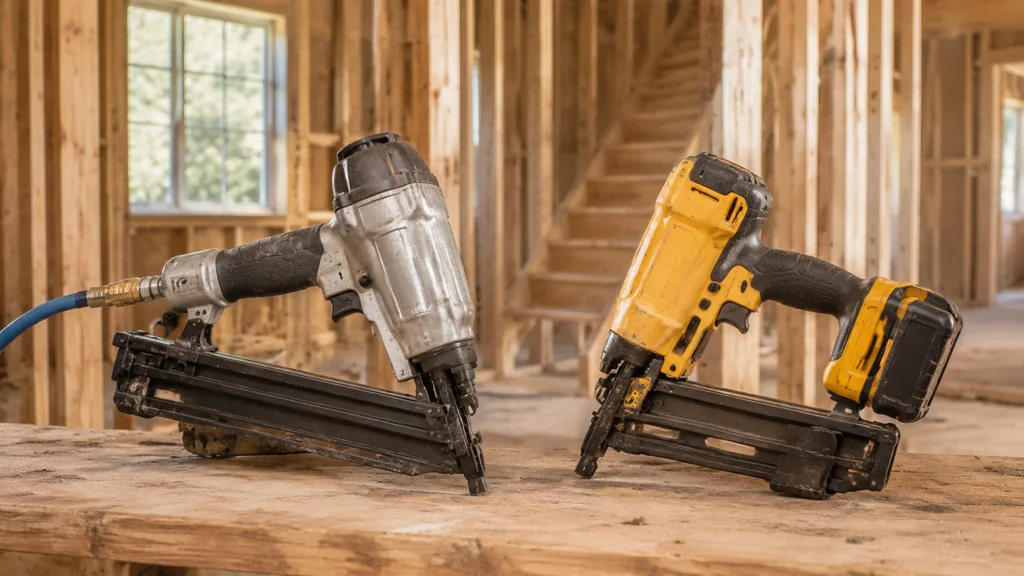
A pneumatic framing nail gun is the better buy if you frame often and work where a compressor can sit: the tool is lighter in the hand, has no battery to replace, and air is cheap to run. A cordless framing nailer wins on repair work, remote lots and overhead jobs where dragging a hose is worse than carrying a battery. Buy a nail gun that matches the work you actually do; the spec sheet is only one part of the decision.
Start With the Job, Not the Tool
The framing nail gun drives most of the fasteners on a framing crew. Sheathing, studs, plates, blocking, trimmers. The tool that drives those fasteners decides how fast the walls go up and how tired you are at four in the afternoon.
So answer three questions before you shop. Where will the work happen? How many days a year will you frame? Is there power on site?
The answers usually point one way. A remodeler hanging a few walls, rebuilding a garage, or fixing a deck frame needs a tool that starts on the first trigger pull wherever the truck is parked. A crew sheathing a whole house wants air, because the compressor stays put and the guns stay light.
The original magazine held 400 to 600 nails, per the historical record, which tells you how early the capacity race started. Check local suppliers for compatible parts and nails before you commit to a platform.
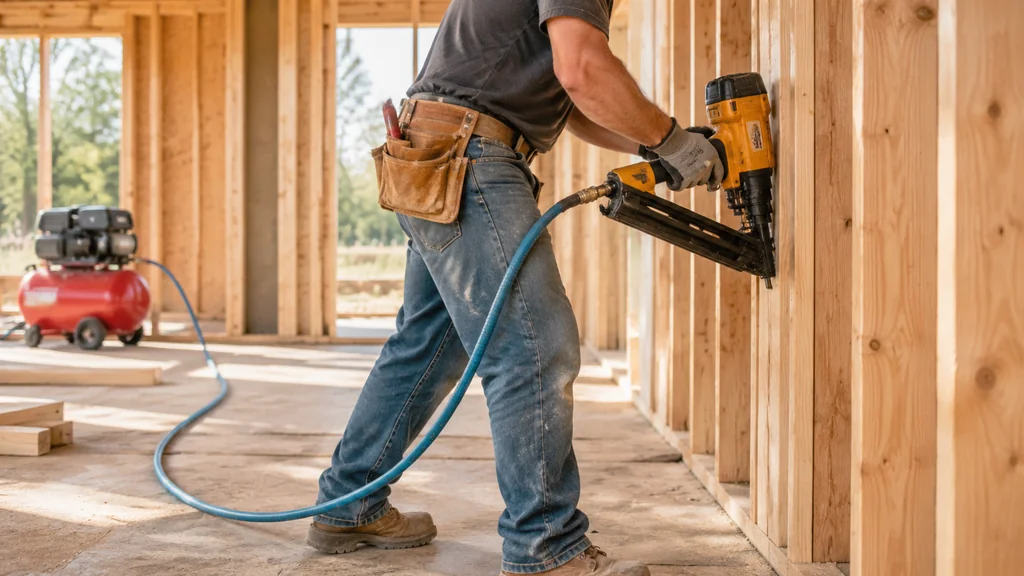
How a Pneumatic Framing Nailer Works and What It Costs to Run
A pneumatic nailer is a simple machine. Compressed air pushes a piston, the piston drives the fastener, and a return spring resets the tool. Fewer parts than a cordless gun, and fewer parts to fail.
The trade-off is the air system. You need a compressor sized for the tool, a hose long enough to reach the work, and fittings that do not leak. A leaky coupler costs you pressure at the gun and makes every shot feel weak.
Running cost is where air looks attractive. A pneumatic tool has no battery to buy, charge or replace, and over a few years of steady work that difference adds up. A battery platform you already own changes the math, so price the whole kit before you decide.
Two habits keep an air gun reliable. Drain the compressor tank at the end of every day, because accumulated moisture can damage or impair air tools. Oil the tool as often as the manual says, and no more.
One more thing about capacity. Check the spec sheet for the exact count on any tool you buy, because a bigger magazine means fewer reloads on a long wall. A palm nailer is a different animal entirely and drives fasteners with repeated hammer blows of around 40 hits per second, which suits tight work such as joist hangers rather than production framing.
What a Cordless Framing Nailer Gives You
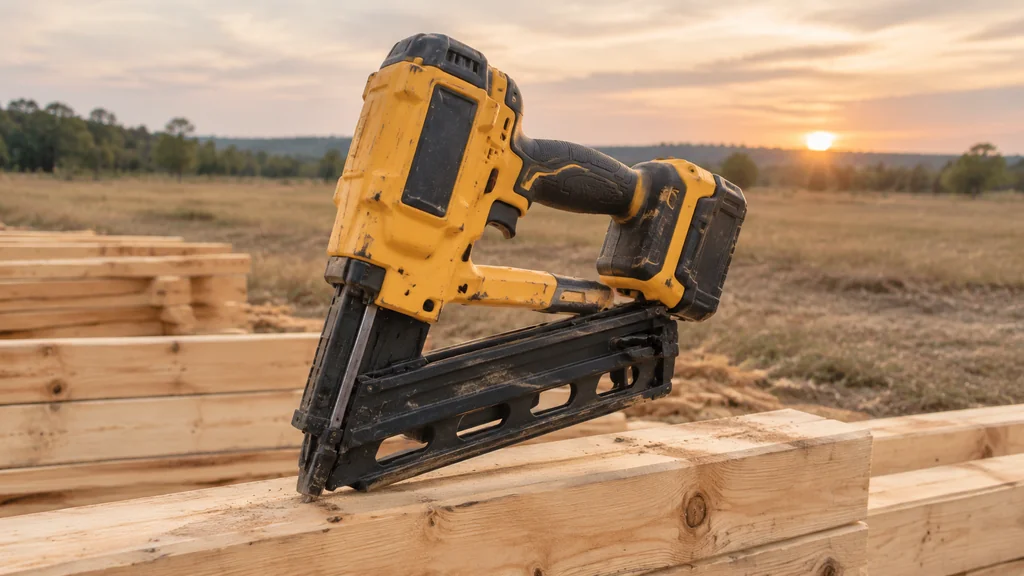
A cordless framing nailer runs on a battery and drives fasteners with either a flywheel or a gas cartridge, depending on the design. You pick it up, load a strip, and work. No hose to drag over sawhorses, no compressor to start, no extension cord to trip over.
That freedom is worth real money on certain jobs. A repair on a second-floor deck, a shed at the back of a lot with no outlet, a fence frame in a field. The cordless gun does all of it without a generator.
The costs are honest and predictable. The tool costs more up front, and the battery is a wear item you will replace. It is also heavier in the hand, which you feel after an hour of nailing over your head.
Battery platforms matter here. If you already run one brand’s batteries for your drill and saw, buying the bare tool and sharing batteries is the cheapest route into cordless framing. If you are starting fresh, price the whole kit before you commit. Cordless guns also need care in cold weather, so follow the manufacturer’s storage and operating guidance and keep packs out of a frozen truck bed.
Setting Up Either Gun: The Procedure
Whichever you choose, the setup routine is the same in spirit. Prepare the tool, prepare the material, then work in a rhythm you can hold all day.
- Read the manual for the tool’s nail angle, nail length range and air or battery requirements, and check the spec sheet against the fasteners you plan to use.
- For air, set the compressor regulator to the tool’s rated pressure and drain the tank before you start.
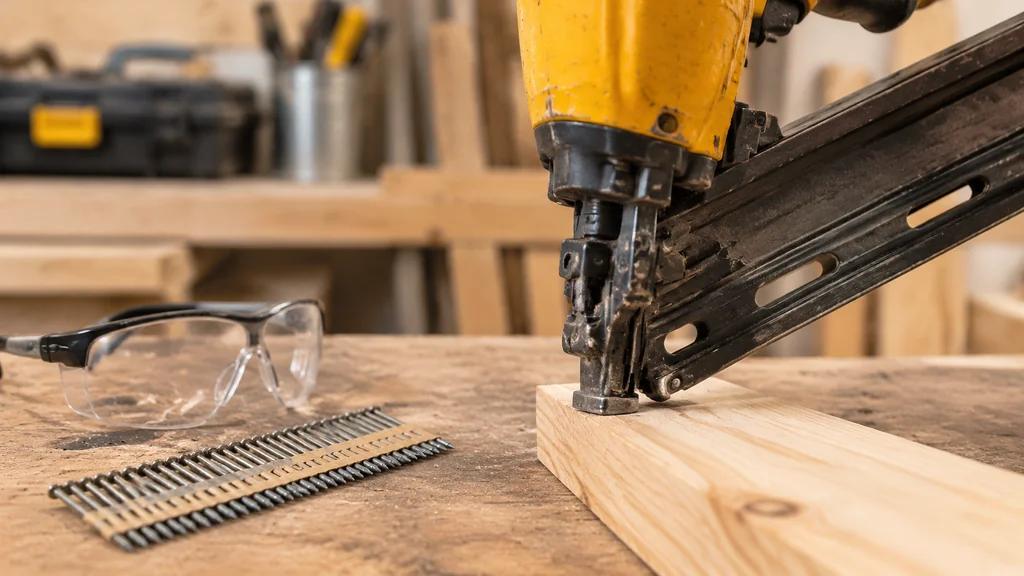
- Load a full strip of framing nails, confirm the angle matches the magazine, and check that the follower is locked behind the nails.
- Set the depth adjustment on a scrap piece of the same lumber you will be nailing, then test-fire into the scrap until the heads sit just below the surface.
- Connect the air hose with the tool pointed away from you, or insert the battery with the trigger untouched.
- Work with a consistent stance, keep your free hand clear of the nail path, and reload before the magazine runs dry rather than mid-wall.
- At the end of the day, disconnect the air or pull the battery, clear the magazine, and wipe the tool down.
That depth-setting step is the one people skip, and it is the one that decides whether your sheathing sits flush or stands proud. Set it on scrap every time you change lumber, because a soft stud and a dense one want different settings.
If you are cutting your own studs and plates on site, the blade you choose changes the cut quality more than most people expect, and our guide to kerf and blade width explains why. For tearing out old framing before you rebuild, the blade and technique advice in our reciprocating saw basics for demolition cuts will save you time.
Weight, Balance and Overhead Work
Framing is not all waist-high work. You nail headers, rim joists, blocking between studs, and sheathing over your head. Tool weight matters most in exactly those positions.
A cordless gun puts the battery and the drive mechanism in your hand. That weight is the price of freedom from the hose, and it is a fair price on short jobs. On a full day of overhead work it adds up.
Balance matters as much as raw weight. A gun that hangs level in your hand points where you look. A nose-heavy tool makes you fight the work piece on every shot. Handle both before you buy, ideally with a battery or hose attached, and test the tool overhead as well as at waist height.
Safety: The Part Nobody Argues About
Nail guns are not toys, and the numbers back that up. NIOSH reports nail guns cause about 37,000 emergency room visits each year among residential carpenters and others, and 60% of those visits are work-related. The CDC puts the wider figure at about 42,000 people a year going to emergency rooms with nail gun injuries, and the CPSC estimates treatment costs at least $338 million per year nationally.
The trend behind those numbers is not encouraging either. Nail gun injuries in the United States tripled between 1991 and 2005, and a 2002 CPSC engineering report found acute injury rates are twice as high among users of contact-trigger nail guns. That is why the trigger type matters more than the power source. According to the CDC, approximately 65% to 69% of contact-trip tool injuries could be prevented by sequential-trip triggers, and OSHA and NIOSH issued a joint nail gun safety guide in September 2011 that still reads as current advice.
So here is the short list of rules I will not bend on. Never disable the contact safety. Never carry a connected gun with your finger on the trigger. Never point the tool at anything you are not willing to destroy. Never try to clear a jam with the air connected or the battery in. Eye protection is not optional either, because framing nails can ricochet off a knot and a worn magazine can fire a strip sideways. Wear glasses rated for impact, and wear them every shot.
When to Call a Pro or Rent Instead
Buying a framing nailer for one shed is a poor trade. Rent the tool for the weekend, or hire the framing out and keep your weekends.
Check local requirements and consult a qualified professional where required, especially for load-bearing or engineered work. A nail gun does not make you a framer, and a bad frame is expensive to fix.
Rent when the job is short and the tool is expensive. A rental yard may provide a pneumatic gun and a compressor for less than buying, depending on rental rates and duration, and you can try the weight and balance before you commit. That test is worth more than any review you will read.
If you are cutting metal connectors, brackets or flashing on the same job, our guide to cutting metal with a circular saw covers the blade and safety setup that keeps that work clean. If you are drilling anchor holes for those connectors, the differences in our comparison of a hammer drill and a rotary hammer for concrete decide which tool you actually rent. And if you are still deciding what drives your screws and lags, our breakdown of an impact driver versus a drill settles that argument before you spend.
For a homeowner building a deck frame or a shed, a cordless gun and a few boxes of nails is often the whole purchase. For anyone framing regularly, the air gun and a decent compressor is the practical long-term setup. Check parts, service and warranty support before buying, because a gun you cannot get a rebuild kit for is a paperweight.
Framing Nailer FAQ
Do I need a compressor for a cordless framing nailer?
No. A cordless framing nailer runs on a battery, so it needs no compressor, hose or power outlet. You charge the batteries and work wherever the job is.
Which is cheaper to run, air or battery?
Air usually costs less to run over time, because a pneumatic tool has no batteries to buy or replace. A cordless gun costs more up front and adds battery cost later, so the crossover point depends on how often you frame.
Can a framing nailer drive nails into engineered lumber?
Check the spec sheet for the tool and the fastener before you try. Engineered lumber and some dense species need specific nails and sometimes a higher-pressure tool, so test on scrap first.
How many nails does a framing nailer hold?
Check the spec sheet for the exact count on your tool, because capacity varies by model and magazine type. A larger magazine means fewer reloads on a long wall.
Is a palm nailer a substitute for a framing nailer?
No. A palm nailer is a companion tool for tight spots such as joist hangers, not a replacement for a framing gun. Keep the right tool for the right fastener.
Thank you for reading!