
A dado blade cuts a flat-bottomed groove wider than a standard saw kerf, and a stack gets there by combining two outer blades with chippers between them. Setup is a sequence: unplug the saw, build the stack to the width you need, fit a matching throat plate, then prove the cut on scrap before any real board goes near it. That order supports safe setup.
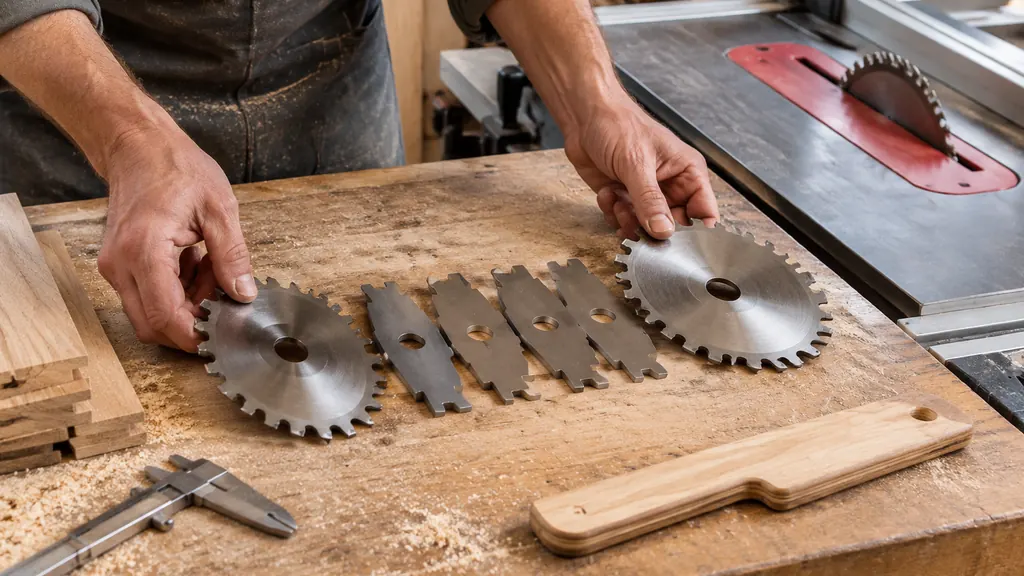
What a Dado Set Actually Is
A dado set combines two toothed outer blades with flat chippers between them. The outer blades cut the groove edges, while chippers clear the middle. Add or remove chippers to change the groove width. A dull chipper can leave a rough floor, and a chipped outer tooth can tear the shoulders.
Most sets are built around an 8 inch diameter, which suits the saws sold in the United States and Canada for home shops. A smaller 6 inch set exists for compact saws with less motor to spare. Check the spec sheet for your saw before buying anything, because arbor length and motor power decide what you can actually run.
A wobble dado uses one blade tilted on a hub. A router table with a straight bit can cut grooves in narrower stock.
Sizing the Groove Before You Touch the Saw
Measure the shelf, panel, or drawer bottom that has to sit in the groove. Measure the actual shelf, panel, or drawer bottom. Plywood may be under its nominal size, and hardwood moves with the seasons. Build the stack to match the measured thickness, then check it with a caliper. Set the groove depth to roughly a third of the stock thickness and test-cut matching scrap.
If the fit is loose, add a shim or thin chipper. If it is tight, remove one. Forcing a panel into the groove with a mallet can split the shoulder.
Building the Stack in the Right Order
Follow the order shown in the set manual.
- Unplug the saw and wait for the blade to stop completely.
- Remove the throat plate and the arbor nut, then take off the standard blade.
- Slide the inner blade onto the arbor, teeth pointing the direction marked on the blade body.
- Add chippers one at a time until you reach the width you measured.
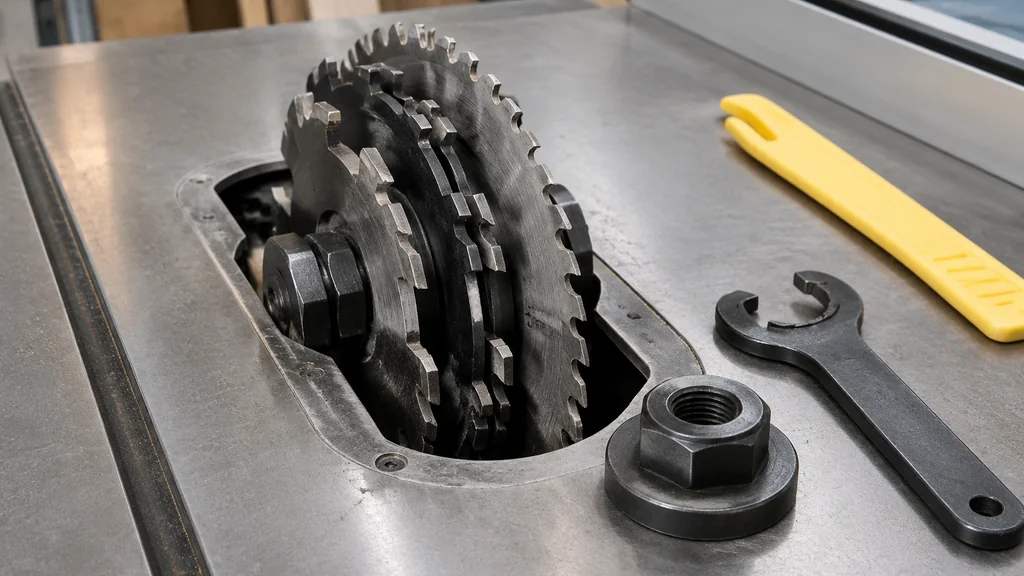
- Fit the outer blade, then the arbor washer and nut.
- Tighten the nut firmly with the wrench that came with the saw. A loose stack is dangerous.
- Raise the stack through a dado throat plate and check clearance by turning the arbor by hand.
Keep the arbor washer in place, even with a wide stack. A standard throat plate has a narrow slot, so use a dado plate with a wide opening.
Setting Depth and Making the Test Cut
With the saw unplugged, use matching scrap to set the blade height. Raise the stack until the teeth touch the scrap, then lock the height. Clamp matching stock to a miter gauge or sled and feed steadily through the saw. Check the test cut’s width, depth, and floor for ridges.
If the floor is ridged, a chipper is out of position or the stack is not seated flat against the arbor flange. Take it apart and look. Ridges mean the panel will rock in the groove, and a rocking shelf is a shelf that squeaks for the rest of its life.
Feed steadily to avoid burning the edges. If the saw labors, take a shallower pass. A jobsite saw with a small motor may need two passes.
Safety Rules That Are Not Negotiable
A dado stack removes substantial material, so follow the saw manual and use care.
Never run a stack without a guard or a proper splitter setup. Many saws cannot fit both over a wide stack, and that is exactly when people take the guard off and leave it off. If your saw cannot be guarded for this cut, use a sled with a blade guard tunnel, or find another way to cut the groove. A router table with a straight bit is slower and safer for narrow work.
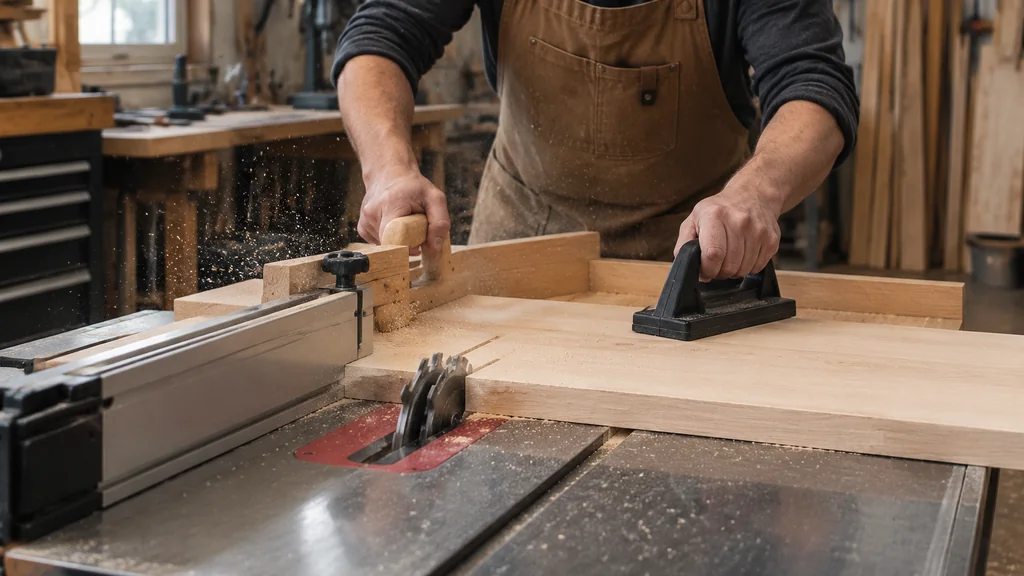
Kickback is the real risk. A stack grabs a lot of material, and a board that lifts or twists gets thrown. Stand to the side of the blade. Use a push stick and a push block, and keep your hands out of the path.
Never reach over a running stack. Not for an offcut, not for a pencil. Wait for the blade to stop.
No gloves near the blade. Gloves catch and pull. Bare hands with push sticks are safer.
Check the arbor and the nut every time you change the stack. A stack that walks loose at speed is a projectile. Tighten it, then check it again after the first cut.
Respect the saw’s limits. A benchtop saw with a small motor and a short arbor may not take a full stack. Check the spec sheet and the manual. If the arbor is too short to seat every part with the washer and nut fully engaged, the answer is no.
If you are building jigs and fixtures for these cuts, match each fastener to the load. The guide to screwing into drywall anchors discusses fasteners.
Chippers, Shims and Width That Actually Fits
Plywood and planed shelves vary in thickness, so shims can fine-tune the groove width. Place them outside the chippers and follow the set’s limits. Measure the assembled stack across the teeth with a caliper, then test-cut. A dedicated dado sled can remain set up for a frequently used width.
When to Call It and Use Another Method
Use a router for grooves in finished cabinets or stopped grooves. A router table can also help with narrow stock. Check arbor length and motor capacity before using a dado stack.
Clean pitch from chippers with blade cleaner, and sharpen the teeth when groove shoulders begin to tear. The notes on Forstner bits and when they beat a spade bit discuss how dull edges affect cuts. Label the storage box with commonly used assembled widths. The lithium-ion battery charging and storage guide covers care for cordless tool batteries.
Dado Blades and Stacks FAQ
Can I use a dado stack on any table saw?
No. The saw needs a long enough arbor to seat every part with the washer and nut fully engaged, a motor with enough power to turn the stack, and a throat plate with a wide enough opening. Check the manual and the spec sheet for your model before you buy a set. Many compact and jobsite saws are not rated for one.
How wide can a dado stack cut?
It depends on the set and saw. Check the set specifications and saw manual, then measure the assembled stack with a caliper.
Why does my dado leave ridges in the bottom of the groove?
A ridged floor usually means a chipper is out of position, the stack is not seated flat against the arbor flange, or a chipper is dull. Take the stack apart, clean the mating faces, and reassemble in the order the manual shows. Test on scrap before cutting the real part.
Do I need a special throat plate for a dado stack?
Yes, on most saws. A standard throat plate has a slot sized for a normal kerf, and a wide stack will catch in it. Buy the dado plate made for your saw, or make one from hardwood or plywood and cut the slot with the stack itself, raising it slowly.
Is a router table safer than a dado stack?
For narrow stock and stopped grooves, yes. The cutter is smaller, the work is easier to control, and there is less material being removed in one pass. For long grooves in wide panels, a stack on a table saw with a sled and push blocks is efficient and manageable. Match the method to the cut.
Thank you for reading!