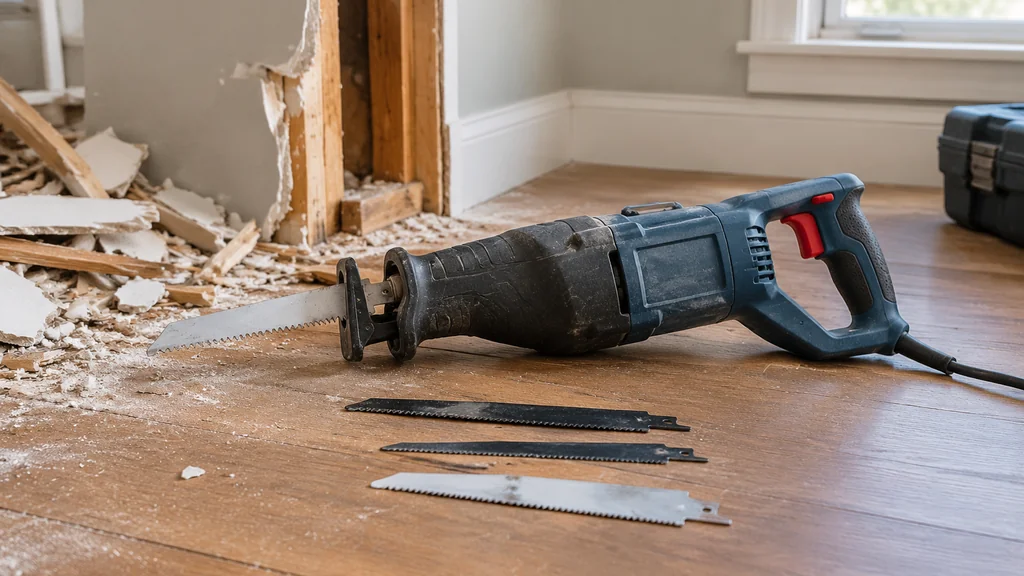
A reciprocating saw cuts by pushing a short, stiff blade back and forth in a straight line, which makes it the tool you reach for when a cut is buried inside a wall or a pipe run. The machine does the work; the blade decides whether the cut is clean or a mess. Fit the right blade for the material, keep the shoe against the work, and let the teeth do the cutting instead of forcing the tool.
What a reciprocating saw actually does well
This is a demolition and rough-in tool. It shines where a Circular Saw or a Handsaw cannot reach: cutting a stud flush to a floor, slicing a nail-embedded board out of a frame, trimming a Cast Iron or PVC drain pipe inside a cabinet, or freeing a window frame that is nailed shut. The stroke is short and the blade is supported at one end only, so it will wander if you push it sideways.
The blade clamp, the stroke length and the shoe should be in good shape before you start cutting anything structural.
The tool cuts on the forward and return stroke on most models, so the blade stays hot and the cut stays fast. That speed is also why it is unforgiving. A reciprocating saw will happily cut through a live cable or a water line if you are not watching where the blade exits.
Choosing the right blade for the material
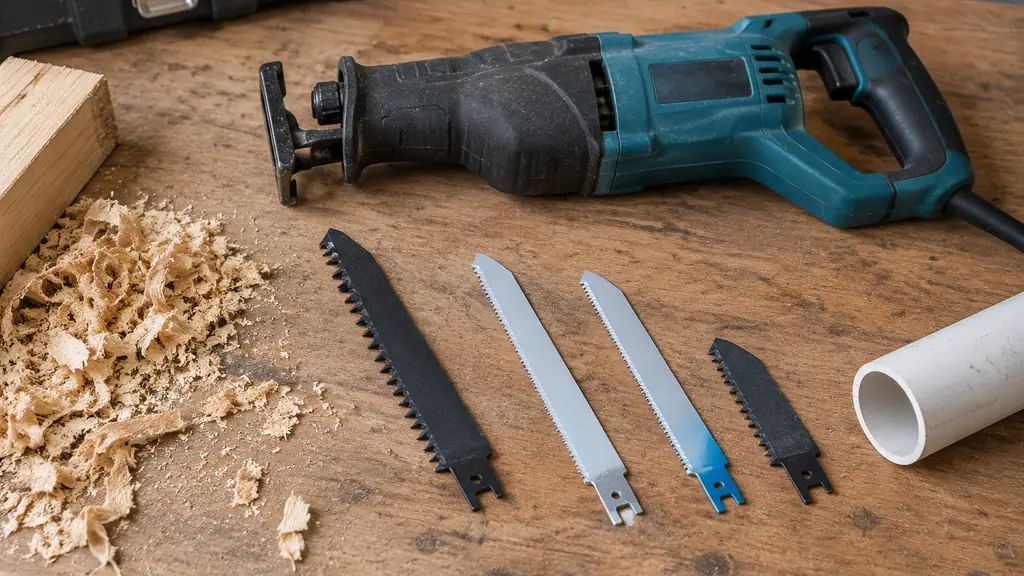
Blade selection is where most bad cuts begin. The tooth pitch, the blade length and the material of the blade itself all need to match the job. A wood blade in metal will strip its teeth in seconds, and a fine metal blade in demolition lumber will clog and burn.
- Wood and demolition: coarse teeth, long blade, designed for nails. These are the blades for studs, plywood and framing with embedded fasteners.
- Metal: fine teeth, short blade, bi-metal construction. Use them on pipe, conduit, angle iron and sheet.
- PVC and plastic: a medium tooth blade with a clean kerf keeps the pipe from chipping at the cut line.
- Drywall and plaster: a short, stiff blade lets you cut an opening without punching through the far side of the wall.
- Pruning and landscape work: a dedicated coarse blade for roots and branches, kept out of the tool bag you use indoors.
Match blade length to the cut. The blade should be long enough to pass through the material at full stroke without the shoe bottoming out, but not so long that it whips. Check the spec sheet for the stroke length of your model and pick a blade that clears it.
Fitting and checking the blade
The blade clamp is the weak point on any reciprocating saw, and a loose blade is how people get hurt and how blades snap. Before every session, fit the blade, tug it hard, and confirm it is locked.
- Unplug the saw or pull the battery pack.
- Open the blade clamp and push the blade in until it seats fully against the stop.
- Release the clamp and pull hard on the blade to confirm the lock engages.
- Check the teeth point the right way for the cut you are making.
- Set the shoe so it rests against the work with the blade exposed only as far as needed.
- Run the saw for a second in the air and listen for wobble or rattle.
If the blade wanders in the clamp, stop. A worn clamp is a repair, not a workaround. On older tools the clamp screw works loose with vibration, so check it again after a few minutes of cutting.
Making clean demolition cuts
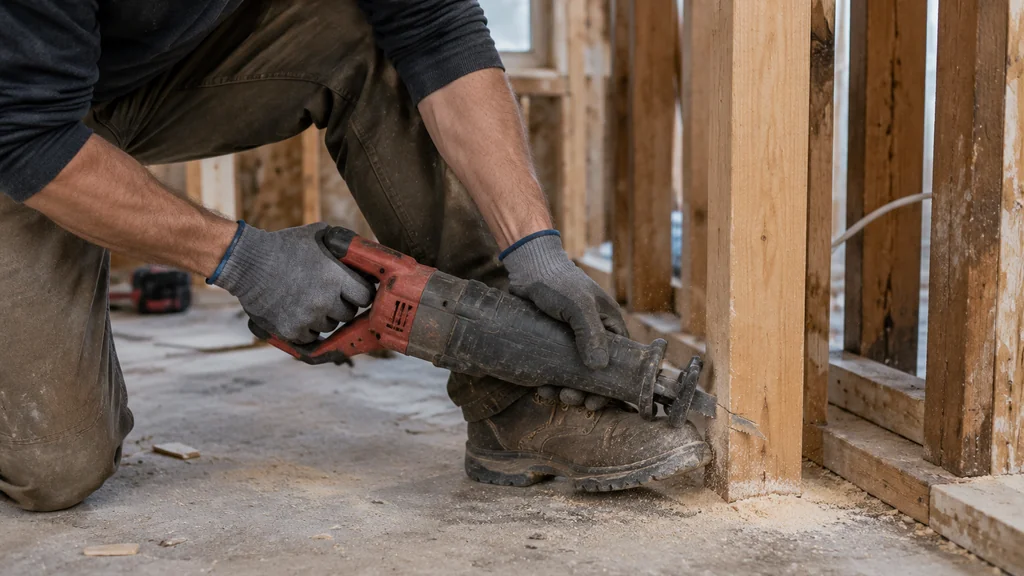
Mark the cut line on both faces of the material when you can reach them. A reciprocating saw cuts blind on the back side, and that is where pipes, cables and ducts live. Shut off the circuit and the water before you open a wall, and confirm it is off at the fixture.
Start the saw before the blade touches the work, then bring it in slowly with the shoe flat against the surface. Let the blade find its own speed. Pushing harder makes the blade flex, overheats the teeth and produces a curved cut you cannot fix.
For a flush cut against a floor or a wall, flex the blade slightly so it cuts parallel to the surface, or fit a short blade and use the shoe as a guide. For long straight cuts in sheet goods, clamp a straightedge and run the shoe along it. If you are breaking down a lot of sheet material, a Track Saw or Table Saw will give you a cleaner edge, and the comparison in this guide to track saw versus table saw for sheet goods is worth reading before you buy.
Keep the blade out of the cut when you stop. A hot blade left buried in wood can scorch the kerf and set up a crack.
Cutting pipe, conduit and metal
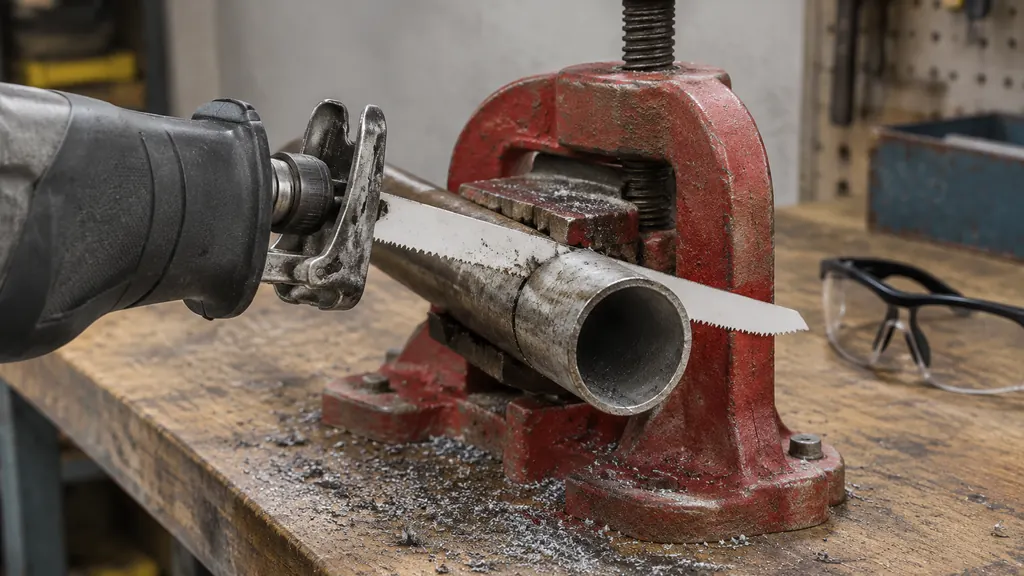
Metal is where a reciprocating saw earns its keep, and where a dull blade costs you the most time. Use a fine Bi-Metal blade, run the saw at a slower speed if your model has variable speed, and keep a little Cutting Oil on the line for thicker sections.
Clamp the pipe so it cannot spin. A pipe that turns with the blade will grab and kick. Cut square to the pipe axis, and support the offcut so it does not drop and pinch the blade at the end of the cut.
For thin sheet and conduit, a light touch and a short stroke keep the teeth from snagging. If you are cutting a lot of flat metal, a circular saw with the right blade is often faster, and the method in this piece on cutting metal with a circular saw covers the setup properly.
Safety and the mistakes that cost fingers
Reciprocating saws cut fast and blind, and the blade exits where you cannot see it. That combination is why so many injuries happen on the back side of a wall.
- Never cut toward your body or toward a hand holding the work.
- Keep both hands on the tool, one on the front shoe grip.
- Wear eye protection. Follow the saw maker’s instructions for gloves, and avoid loose or snag-prone gloves.
- Shut off power and water before opening any wall or floor.
- Do not cut into a wall you have not checked for cables, pipes and ducts.
- Never remove the shoe or defeat the clamp to reach a tight spot.
- Keep the cord or battery clear of the cut line.
The other common mistake is using a reciprocating saw for finish work. It is a rough tool. If the cut will be visible, cut oversize and trim with a handsaw or a fine-tooth blade, or plan the joint so the rough edge is hidden.
When to call a pro
Structural work is the line. If you are cutting a beam, a header, a load-bearing stud or anything holding up a floor, stop and get an engineer or a licensed contractor to look at it. A reciprocating saw makes it easy to remove material that a house needs, and the damage shows up slowly.
The same goes for anything inside a service panel, gas lines and buried utilities. Check local requirements before doing this work. For the rest, a reciprocating saw is a useful tool once you respect the blade and the blind side of the cut. If you are setting up a shop and weighing bigger purchases, this table saw buying guide for contractor, hybrid and cabinet models will help you spend the money once.
Reciprocating Saw FAQ
What is the difference between a reciprocating saw and a Sawzall?
Any brand of reciprocating saw does the same job. The differences between models come down to stroke length, blade clamp design and whether the speed is variable.
Can a reciprocating saw cut through nails and screws?
Yes, if you fit a demolition blade rated for embedded fasteners. A coarse wood blade will lose teeth on nails. Slow the saw down when you hit metal so the teeth cut instead of chattering, and expect the blade to wear faster in nail-heavy lumber.
Why does my blade keep snapping?
Blade breakage usually comes from sideways pressure, a loose clamp or a blade that is too long for the cut. Keep the shoe against the work, let the teeth cut, and check the clamp before each session. A bent blade should be replaced, not straightened.
Can I cut PVC pipe with a reciprocating saw?
Yes. Use a medium-tooth blade, support the pipe so it cannot move, and cut square to the axis. Clean the burr off the cut end with a knife or sandpaper before you glue or fit the joint, or the fitting will not seat properly.
How do I cut a straight line with a reciprocating saw?
Clamp a straightedge and run the shoe along it, or mark both faces of the material and check your line as you go. Keep the blade short and the speed steady. For visible finish cuts, cut oversize and trim with a handsaw.
Thank you for reading!