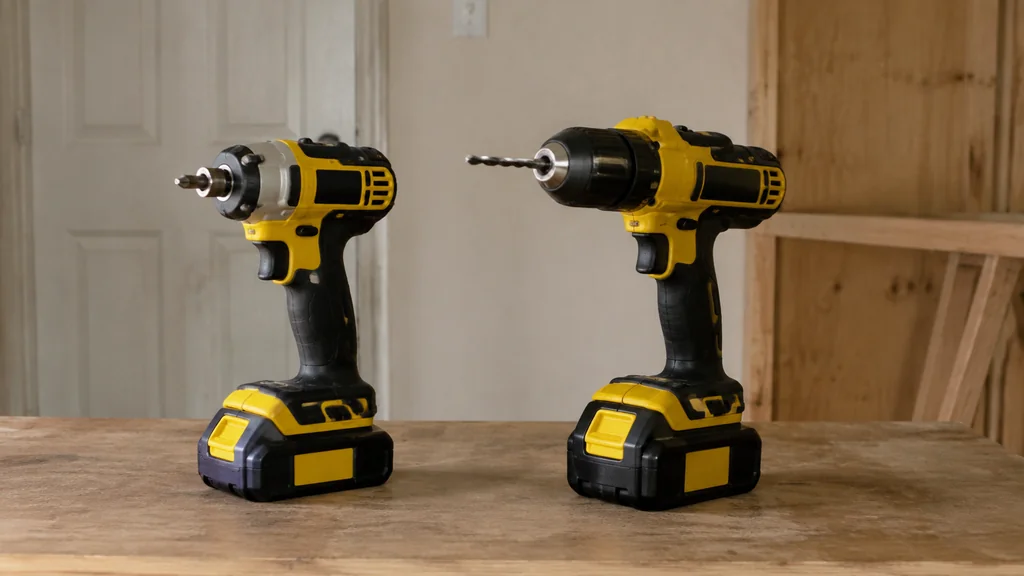
An impact driver drives screws and long fasteners with rotary blows, while a drill spins a bit steadily to bore holes and mix materials. Buy the drill first if you are starting from nothing, then add an impact driver for driving. Trying to use an impact driver as drill for clean holes is where most beginners get into trouble.
What Each Tool Actually Does
The two tools look like cousins and behave like strangers. A drill turns the chuck at a steady speed and feeds a bit into wood, metal or masonry. An impact driver adds a rapid rotary hammer action once the fastener meets resistance, so the bit hammers around its axis in tiny steps.
The drill is the older idea. Humans were applying rotary tools around 35,000 BC, and the core drill shows up in ancient Egypt by 3000 BC. The electric drill was patented in 1889 by Australian mining engineers Arnot and Brain, and the first portable handheld drill came from Wilhelm and Carl Fein of Stuttgart, Germany in 1895. Black & Decker patented the first trigger-switch, pistol-grip portable drill in 1917.
A drill can drive a screw. An impact driver drives fasteners with rotary blows.
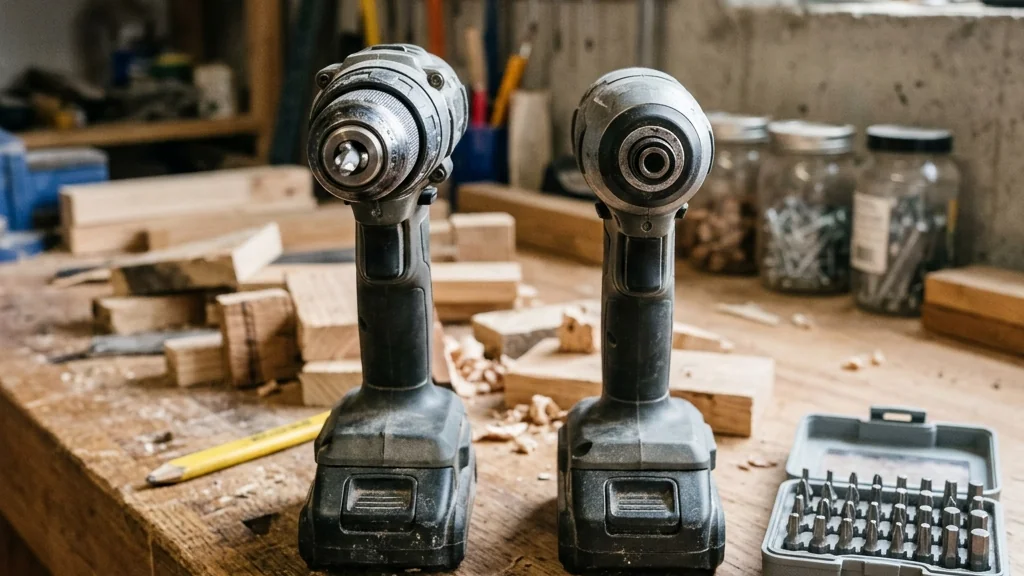
The practical split comes down to the chuck. A drill has a keyed or keyless chuck that grips round-shank bits. An impact driver has a hex quick-release collet that takes bits with a matching hex shank. That single difference decides which tool can hold which accessory, and it is the reason the two tools do not fully replace each other.
Impact Driver as Drill: Where It Works and Where It Fails
You can chuck a hex-shank drill bit into an impact driver and bore a hole in softwood. Plenty of people do it on a quick repair. The result is usually rougher than a drill would give, because the impact action engages as the bit loads up and the hole walls can tear.
The failure cases are more important than the successes. An impact driver takes hex-shank bits, while clean holes in hardwood, plywood or metal demand controlled, steady feed. If you are working with Baltic birch plywood, where tear-out on the face veneer ruins the panel, the impact driver is the wrong tool. The article on Baltic birch plywood grades explains why shops baby that material.
If you are heading into that job, read drilling stainless steel without ruining the bit before you start.
There is also a control problem. The impact mechanism kicks in when resistance rises, so the moment your bit grabs in a deep hole, the driver starts hammering. In thin material or near an edge, that grab can split the workpiece. A drill turns the bit at a steady speed with no impact action, so the cut stays under your control.
Using an impact driver as a drill works for a quick hole in softwood with a hex-shank bit. It is the wrong tool for cabinet work, metal, masonry, hole saws and anything where the hole has to be clean.
Drill and Impact Driver: What the Pair Covers
That division of labour is why combo kits exist and why most trades carry both in the same bag.
The drill handles the tasks that need steady rotation and a real chuck:
- Boring holes in wood, metal and masonry with the right bit
- Running hole saws for pipe and cable
- Driving screws in delicate work where you want clutch control
- Mixing thinset, grout or paint with a paddle
- Drilling pilot holes before driving
The impact driver handles the tasks that need torque and speed:
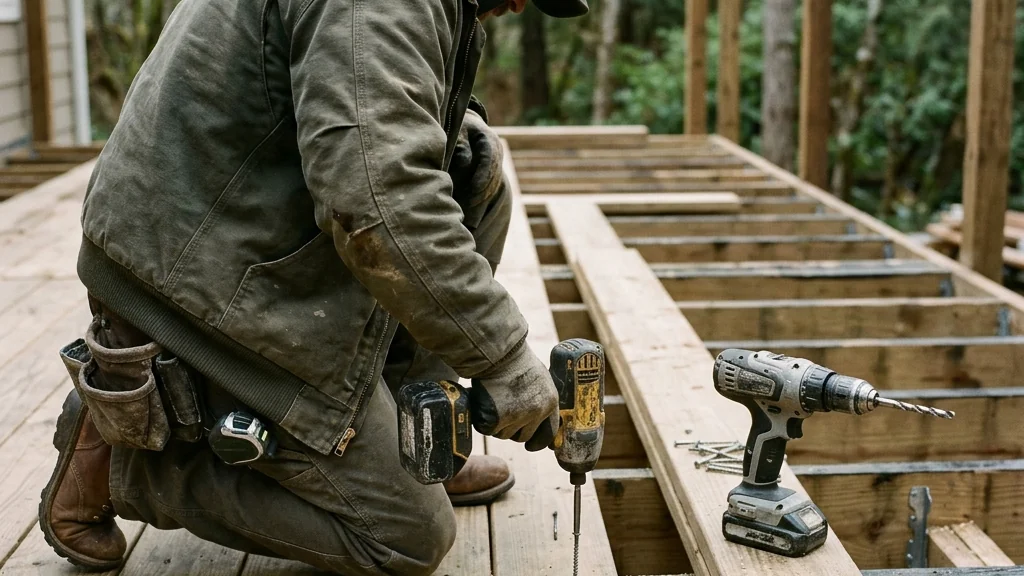
- Driving deck screws, structural screws and long fasteners
- Running lag bolts with the right adapter
- Assembly work with driver bits
- Removing stubborn fasteners, which a drill often cannot break loose
The clutch on a drill is the feature people underuse. Set it low and the drill stops driving when the screw seats, which protects softwood, drywall and cabinet faces. That makes the drill the better choice for finish work and the impact driver the better choice for framing and decks.
Battery voltage matters when you are matching tools. If you are buying into one battery platform, buy the pair on the same platform so the packs swap between them.
How to Choose Your First Tool
If you can only buy one tool right now, buy the drill. It is the more versatile of the two because it bores holes and drives screws, and it accepts the widest range of accessories. With an adjustable clutch it stops driving when the screw seats, which protects softwood, drywall and cabinet faces.
Buy the impact driver first only if your work is dominated by driving fasteners. Long deck screws, structural screws and lag bolts are the driver’s territory, and the drill follows once boring work comes up.
Here is the sequence I recommend for a home shop starting from zero.
- Buy a cordless drill with a keyless chuck, an adjustable clutch and two batteries on a platform you can grow into.
- Add a set of good drill bits for wood, metal and masonry, plus a small driver bit set.
- Add the impact driver on the same battery platform once driving work becomes routine.
- Buy hex-shank driver bits and adapters for the impact driver, and keep them separate from the drill bits.
- Add a hammer drill or rotary hammer only when concrete becomes a regular job, not before.
That last point matters. A hammer drill is a different animal from an impact driver, and the two are often confused. Most electric hammer drills are rated at between 600 and 1100 watts of input power, and their efficiency is usually 50 to 60 percent, so 1000 watts of input yields roughly 500 to 600 watts at the bit. If concrete is on your list, read hammer drill vs rotary hammer for concrete before you spend.
Torque, Speed and Control in Practice
Torque figures on the box are not the whole story. An impact driver’s peak torque is delivered in pulses, so the number tells you how hard it can hit, not how smoothly it feeds a bit.
Speed control separates a good tool from a frustrating one. A variable-speed trigger lets you start slow and build up, which matters when a bit is about to break through or a screw is about to seat. Both tools have one, but the impact driver’s trigger also controls when the impact mechanism engages. Feather it and you can drive a small screw without ever triggering a hammer blow.
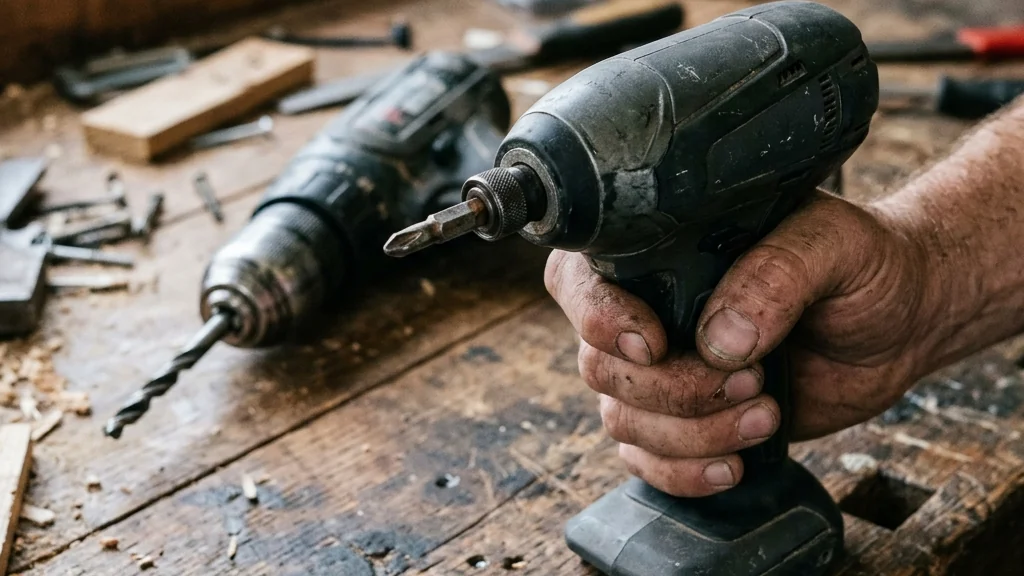
The bit interface is where the tools diverge for good. An impact driver takes hex shanks only. That is why you see so many hex-shank accessory sets on the shelf. They are made for the driver, and they will not fit a standard drill chuck without an adapter.
Check the spec sheet for the torque and speed range before you buy, and match it to the work. A compact driver suits cabinet and assembly work. A heavy-duty driver suits decking and structural screws. Buying the biggest tool on the shelf for light work just means more weight in your hand and less control at the trigger.
Mistakes That Cost You Money
The first mistake is driving screws with a drill and calling it done. The impact action breaks the fastener loose as resistance rises, which is why long deck screws and structural screws belong on the driver.
The second mistake is using an impact driver for holes that need to be clean. If you need a precise hole, reach for the drill.
The third mistake is mixing bit sets. Hex-shank bits go in the driver, round-shank bits go in the drill. Forcing a round bit into a hex collet, or the reverse, damages the tool and the bit. Keep the sets in separate cases and label them.
The fourth mistake is skipping eye protection.
When to Call a Pro
Most drilling and driving in a house is homeowner work.
If the hole you are drilling goes into a wall that might hide wiring or plumbing, stop. A drill or driver will not tell you what is behind the drywall, and a bit through a cable or a pipe can cause serious damage.
For structural fasteners, anchor bolts or anything holding up a deck, a beam or a load-bearing wall, confirm the sizing and fastener specification before starting. The tool is not the hard part there. The specification is.
If you are drilling into masonry and the wall is load-bearing or part of a chimney, a rotary hammer and the right anchor are a different job from a hammer drill and a plastic plug. That is where a mason or a contractor earns their fee.
For everything else, a drill and an impact driver in the same bag will handle it. The pair is the standard kit for a reason.
Impact Driver vs Drill FAQ
Can I use an impact driver as a drill?
Yes for a quick hole in softwood with a hex-shank bit, and no for clean work in hardwood, plywood, metal or masonry. Use a drill whenever the hole has to be accurate.
Do I need both a drill and an impact driver?
A drill alone covers boring and light driving, and an impact driver alone covers driving but not clean holes. The pair covers both jobs, which is why combo kits exist and why most trades carry both. If you can only buy one, buy the drill first because it accepts the widest range of accessories.
What is the difference between a drill and an impact driver?
A drill turns the chuck at a steady speed and grips round-shank bits in a chuck. An impact driver adds a rapid rotary hammer action and takes hex-shank bits in a quick-release collet. The drill is for holes and controlled driving; the impact driver is for driving fasteners with torque and speed.
Can an impact driver drive screws into hardwood?
Yes, and it does it better than a drill on long fasteners because the impact action breaks the screw loose as resistance rises. Pre-drill the pilot hole with a drill first, especially near an edge or in dense hardwood, so the screw does not split the board. The driver then seats the screw without cam-out.
Is a hammer drill the same as an impact driver?
No. A hammer drill pounds the bit along its axis to break masonry, while an impact driver hammers around its axis to drive fasteners. Most electric hammer drills are rated at between 600 and 1100 watts of input power.
Thank you for reading!