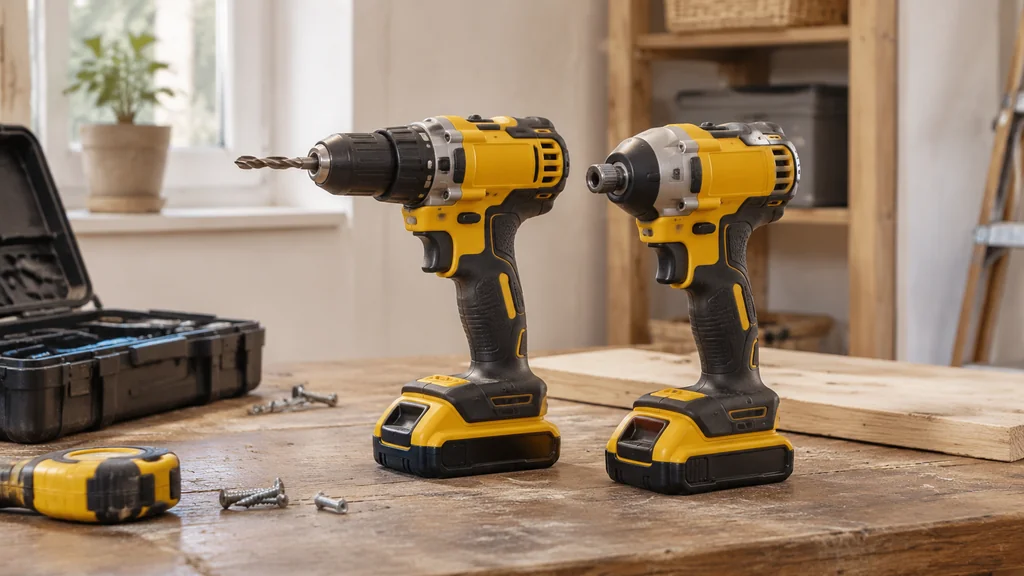
A drill spins a bit to make holes and drive screws slowly with high torque; an impact driver hammers the bit in short rotational bursts to drive fasteners hard. Pick the drill for holes and control, the impact driver for screws and lag bolts, and buy both on the same battery platform so the packs stay useful.
DeWalt Drill and Impact Driver Ranges at a Glance
In September 2022, DeWalt launched POWERSTACK, becoming the first power tool manufacturer with a pouch-style lithium-ion battery platform.
DeWalt sells tools as bare units and as kits, and the same model number can ship with different batteries. Read the box and compare it with the shelf label.
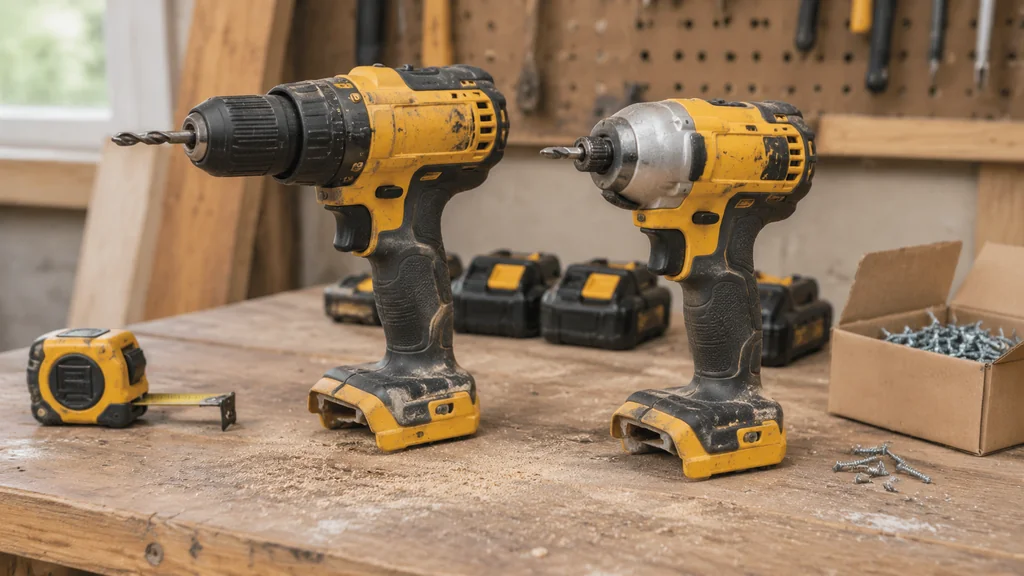
Drill or Impact Driver: What Each One Actually Does
A drill is a boring and driving tool with a chuck that grips round-shank bits. It gives you controlled speed and a clutch that slips when the screw seats, so you do not strip the head or overdrive into softwood.
An impact driver has a spring-loaded hammer mechanism that strikes the bit in rapid rotational blows. That is why it drives long screws without the wrist-breaking kick a drill gives you. The hammering chews the bit shank and the hole wanders.
Here is the practical split I use on my own bench:
- Drill: holes in wood, metal and masonry (with the hammer function on a combi drill), hole saws, auger bits, driving screws where you want fine control.
- Impact driver: deck screws, structural screws, lag bolts with the right adapter, anything where speed and torque matter more than precision.
- Neither: precision joinery. For that you want a drill press or a brace, and a sharp bit. If you are cutting joints by hand, the guide to what a dovetail joint is and where it belongs is a better place to start than any power tool.
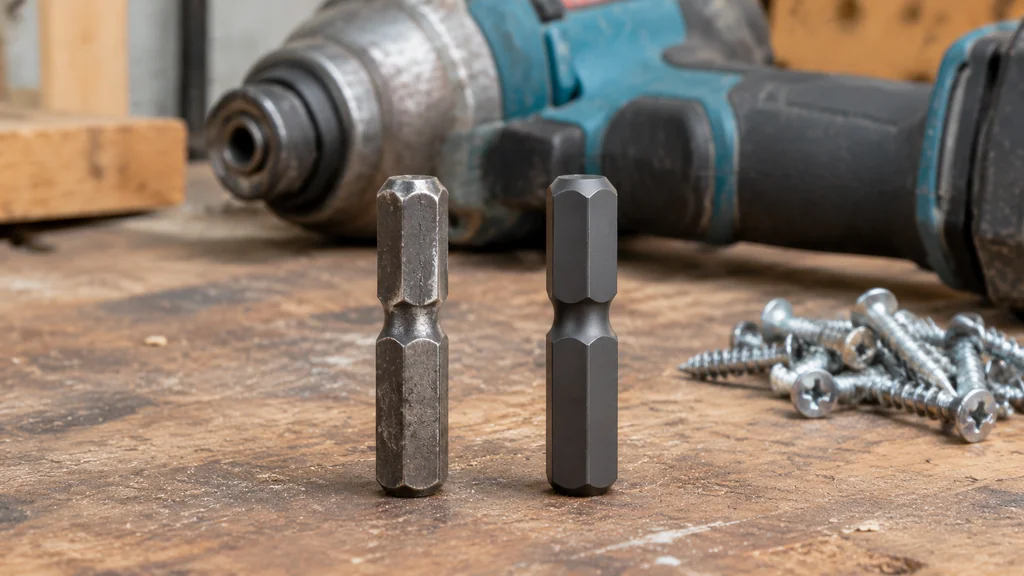
Impact drivers take hex-shank bits, usually the quarter-inch size, held by a quick-release collet. Drills take round-shank bits in a keyless chuck. That single difference decides which tool you reach for.
Matching the Tool to the Battery Platform
The battery is the real purchase. A bare tool is cheap; the packs and charger are where the money sits, and they lock you into one brand.
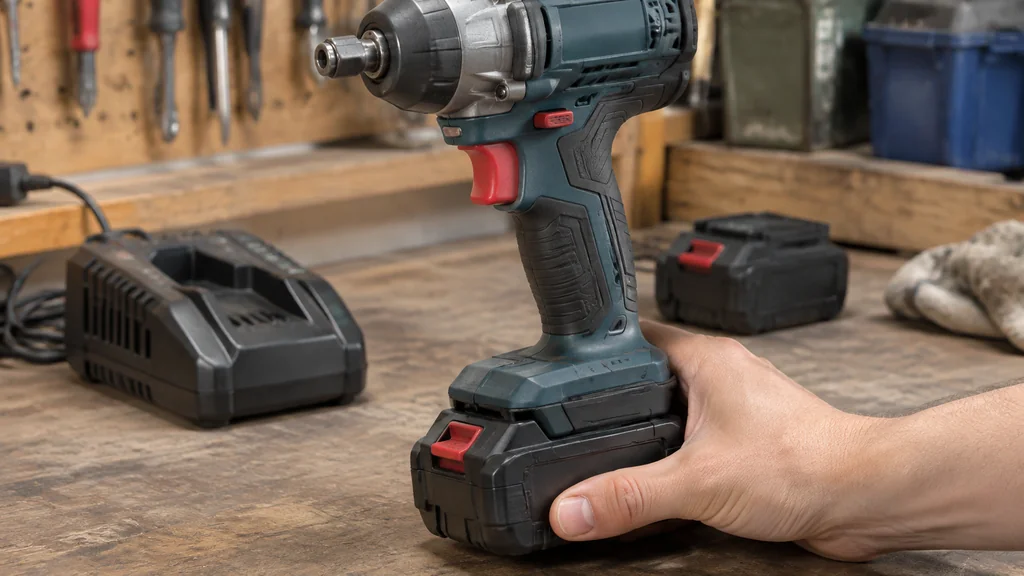
Read the ratings printed on the pack and on the tool before you buy, and keep new purchases inside the family you already own, so one set of packs and chargers serves everything on the shelf.
A few rules I follow, learned the hard way:
- Buy one platform and stay on it. Mixed platforms mean duplicate chargers and packs that never get used.
- Buy the bigger kit once if you can. Kits come with packs and a charger, which a bare tool leaves out.
- Check the pack voltage and the tool’s rating on the label before you assume they match.
- Keep one charged pack on the shelf at all times. A dead battery at the wrong moment is how corners get cut.
- Store packs indoors, away from freezing sheds. Cold cells lose capacity and charge slowly.
Both brands make competent tools, and the deciding factor is usually which platform your mates or your crew already run, because shared batteries save money. Handle both in a shop and see which grip and trigger suit your hand.
What to Check Before You Buy
The spec sheet tells you less than the tool in your hand. These are the checks that separate a good buy from a regret.
Spin the chuck by hand and watch for runout.
Clutch settings. More clutch positions give finer control when driving into softwood or drywall. Count them on the collar.
Speed selection. Two speeds on a drill let you run slow and torquey for driving, fast for drilling small holes. Impact drivers with speed modes are gentler on small screws.
Grip and balance. Hold the tool at arm’s length as if drilling an overhead hole. If the nose dives, the balance is wrong for you.
Bit holder runout on the impact driver. Fit a long bit and spin it. Visible wobble means the collet is loose and your screws will cam out.
Service and spares. Brushes, chucks and triggers should be available. A tool you cannot repair is a disposable tool.
One more check that costs nothing. Look at the fasteners on the tool itself. If they are Torx or Phillips heads you can tighten them when the housing loosens. Sealed housings with no serviceable fasteners tell you the maker expects replacement instead of repair.
Costs and What Drives the Price
Prices move with promotions, so treat any figure you see online as a snapshot. What does not move is the structure of the cost.
Bare tools cost least and assume you own packs. Kits cost more but include batteries and a charger, and the pack is usually the expensive part.
The hidden cost is the bit. Impact drivers eat cheap hex bits. Buy good ones in bulk and replace them when the corners round off. A rounded bit cams out of the screw head, and then you are into extraction work. The method for removing a stripped or rounded screw without damaging the surrounding material is worth knowing before it happens to you.
Common Mistakes With Drills and Impact Drivers
Using an impact driver as a drill. The hammer action ruins twist bits and wanders the hole. Use the drill.
Overdriving screws into softwood. The impact driver will bury a screw head half an inch into pine before you notice. Set the speed low and feather the trigger.
Driving without a pilot hole in hardwood. You will split the board or snap the screw. Drill a pilot hole slightly smaller than the screw shank.
Check the label.
Ignoring the clutch on the drill. The clutch is there to stop you stripping screws and crushing drywall paper. Learn which number suits which material.
Drilling masonry with a wood bit. It burns the flutes and the hole goes nowhere. Use a masonry bit and the hammer mode on a combi drill.
Skipping eye protection. Impact drivers throw bits and broken screw heads. Safety glasses are not optional, and neither is hearing protection when you are driving hundreds of fasteners.
If you are building shelves or a cabinet carcass, the sheet goods matter as much as the tool. Choosing between MDF, plywood and fiberboard changes how the screws hold, and an impact driver on the wrong board will strip out every fixing.
When to Call a Pro
Cordless tools are homeowner territory for drilling, driving and light assembly. Some jobs are not.
I have seen too many sheds wired off a spur by someone with a good drill and no test meter. The tool is not the problem; the scope is.
Call a structural engineer or a competent builder before you cut a beam, notch a joist or remove a wall. An impact driver will happily drive a lag bolt into a joist that should never have been drilled.
Call a pro for masonry anchors into structural concrete, for anything involving gas, and for roof work above a single storey. And if a job needs a hammer drill with a core bit through a cavity wall, hire the tool and the operator together.
DeWalt Drills and Impact Drivers FAQ
What is the difference between a DeWalt drill and a DeWalt impact driver?
A drill rotates the bit continuously and uses a clutch to limit torque, which suits drilling holes and controlled screw driving. An impact driver adds a hammer action that delivers short rotational blows, which drives screws and lag bolts faster with less wrist strain.
Can a DeWalt impact driver drill holes?
It can turn a hex-shank drill bit in softwood for rough work, but the hammer action chews the bit and the hole wanders. For accurate holes in wood, metal or masonry, use a drill with a chuck and the correct bit for the material.
Is a Milwaukee impact driver better than a DeWalt?
Both brands make capable pro-grade impact drivers, and the difference usually comes down to which battery platform you already own or which one your crew shares. Handle both before buying and check the grip, the speed modes and the bit holder for wobble. Brand loyalty is a weaker argument than a pack you can borrow.
Which DeWalt range should a homeowner buy?
The base kits are fine for occasional flat-pack assembly, and the high-output platforms like FlexVolt and POWERSTACK make sense for heavy or daily use.
Do DeWalt batteries fit every DeWalt tool?
No. Check the pack and tool rating on the label before you assume a fit, and never force a pack onto a tool it was not made for.
Thank you for reading!