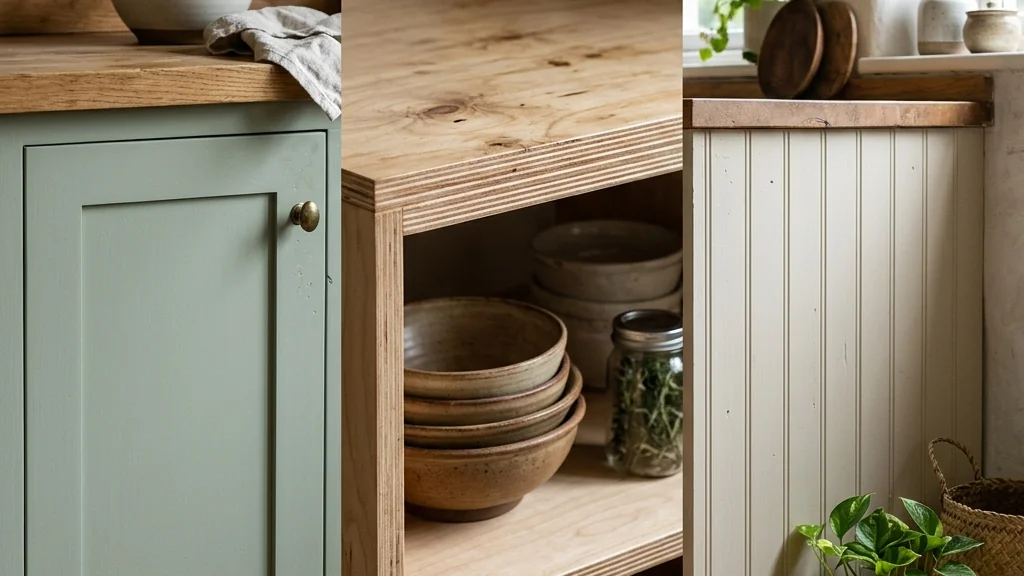
Plywood wins wherever the sheet has to carry load, hold a screw under stress or survive damp, while MDF board wins on flat, smooth surfaces for painted furniture and built-ins, and fiberboard wins on cost for backs, drawer bottoms and door skins. The job decides the pick. Read the core, the strength rating and the moisture exposure before you load the cart.
Start With the Core, Not the Label
Every sheet in this family is wood fibre or veneer glued together. What separates them is how the fibre is arranged.
Plywood is built from thin veneers peeled off a log and glued in alternating directions. That cross-grain layup is why plywood resists splitting along its face and holds up when a load pulls on it. The alternating grain also means the sheet moves less across its width than a solid board of the same size.
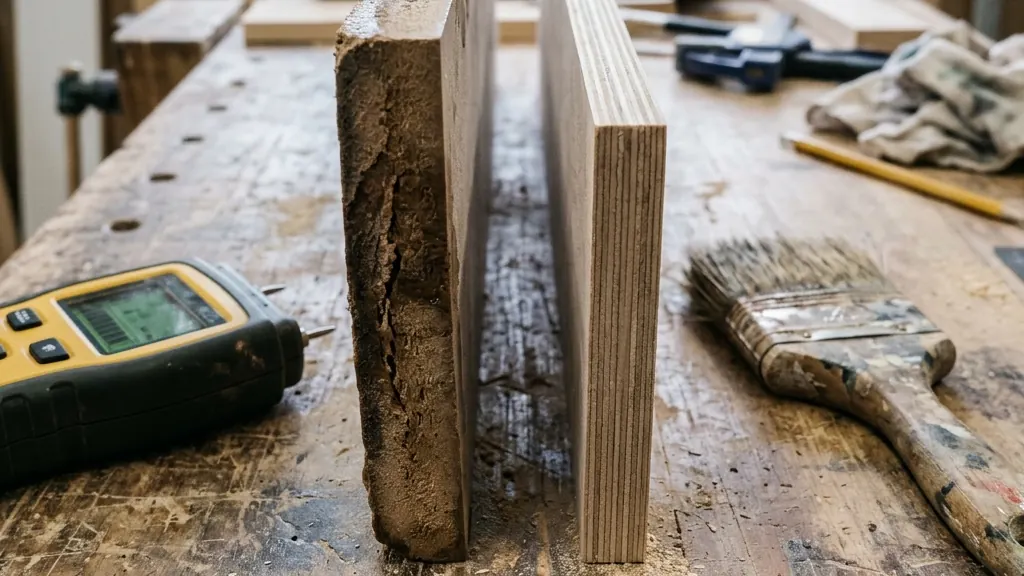
MDF is ground fibre, resin and wax pressed into a uniform mat. There is no grain direction, so an MDF board cuts the same in every direction and machines to a clean edge. The trade-off is that the same uniformity leaves nothing to stop a crack once a fastener pulls out.
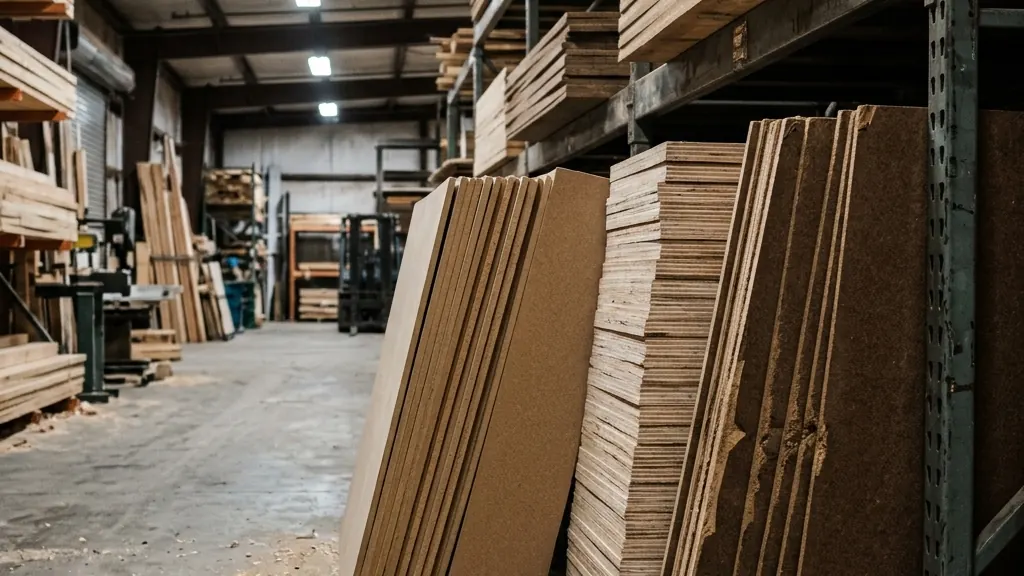
Fiberboard is the umbrella term. High density fiberboard sits at the dense end of that family, hardboard at the thin end, and MDF sits in the middle. When a supplier says fiberboard without a qualifier, ask which density you are getting.
The production line matters for what you buy. A typical disk chipper in an MDF plant runs four to sixteen blades, and the chips are heated for 30–120 seconds to soften the lignin before the fibre is separated. Large-scale MDF production began in the 1980s in both North America and Europe.
How Strong Is Each Sheet, Really?
Strength is where the three sheets part company fastest.
MDF typically has a modulus of rupture of 40 MPa and a modulus of elasticity of 3 GPa. Those figures describe a board that is stiff and reasonably strong in flat bending, which is why MDF shelves and cabinet panels work fine when they are supported at the ends. The same board has poor screw-holding on its edge, so a joint that relies on an edge screw will fail before the panel does.
Plywood carries its strength in the face veneers. A structural sheet is graded for load, and in the United States the national standard for structural plywood production and specification is Voluntary Product Standard PS 1-22. If you are building anything that has to pass an inspection, that stamp is the one to look for on the sheet.
The testing behind those stamps is not casual. APA has been trusted by the industry for over 90 years as an engineered wood testing and certification body, and its 42,000-sq-ft Research Center in Tacoma, WA tests thousands of engineered wood products. APA also publishes over one hundred sixty Product Reports, all free to download, which is where you find the span ratings for a specific panel.
In Europe, MDF is classified for use by the standard EN 622-5, covering load-bearing and non-load-bearing applications. That classification tells you whether the board is classified for load-bearing use.
High density fiberboard sits above standard MDF on density and hardness, which makes it the pick for wear surfaces, drawer runners and thin panels that need to stay flat. It is also heavier and harder on blades, so plan your cuts before you start. A clean cut starts with knowing your blade, and the kerf width guide explains how much material the blade removes and why that matters on a fitted panel.
Moisture, Movement and Where Each Sheet Fails
Water is the great divider.
Standard MDF swells when it takes on water and does not return to its original thickness when it dries. A swollen edge stays swollen, the paint film cracks, and the panel is scrap. Keep standard MDF out of bathrooms, laundry rooms and any spot where a leak can reach the edge.
Moisture-resistant MDF is made with a wax or resin blend that slows water uptake. It is better in a humid room, but it is not a substitute for plywood in a wet zone. Check the label for the rating and read what the manufacturer claims, because the grades differ between suppliers.
Plywood handles moisture far better because the veneers and the glue line resist water when the sheet is rated for exterior use. Exterior-rated plywood is the sheet for sheathing, subfloor patches and anything that sees rain during construction.
Fiberboard is the most moisture-sensitive of the three in its standard form. Hardboard and high density fiberboard are dense enough to survive a damp wipe, but a soaked edge still swells.
Movement is the other quiet failure. Plywood moves across its width with humidity changes, so a wide panel needs a gap at the wall and a proper expansion allowance. MDF moves less in service but swells at a cut edge, so seal every edge you expose. A coat of primer on the cut edge is cheap insurance, and skipping it is how a painted cabinet gets a raised seam a year later.
Cutting and Fastening Each Sheet
The three sheets behave differently under the same blade.
MDF cuts like a dense, uniform material. It makes fine dust, so dust extraction is not optional. It also dulls blades faster than plywood because the resin and density wear the teeth. Use a sharp carbide blade with a high tooth count for a clean edge, and take a light scoring pass on veneered faces.
Plywood cuts cleanly on the face but can splinter on the exit side. Tape the cut line, cut with the good face down on a circular saw, and use a fine-tooth blade. For demolition work where you are cutting out old sheathing or studs, a reciprocating saw with the right blade does the job faster than any circular saw, and the reciprocating saw blade guide covers which blade suits wood, nails and mixed material.
High density fiberboard and hardboard are hard on teeth. Slow the feed, keep the blade sharp, and do not force the cut. If you are cutting a thin hardboard panel, support it fully so it does not chatter.
Fastening is where MDF board punishes shortcuts. A screw driven into the face of MDF holds reasonably well. A screw driven into the edge holds poorly and will strip if you overtighten. Predrill every edge screw, use a coarse-thread screw designed for particle and fibre board, and keep the screw away from the very edge.
Plywood holds screws well in both face and edge, which is why it is the sheet for anything that gets assembled and taken apart. Fiberboard holds screws poorly in thin sections, so it works as a panel material and fails as a frame material.
If you are cutting metal trim or hardware for the project, the guide to cutting metal with a circular saw covers the blade and safety setup, because the wrong blade on a metal cut is how people get hurt.
Cost, Finish and the Jobs Each Sheet Owns
Cost follows density and process. Fiberboard is usually the cheapest sheet per square foot, MDF sits in the middle, and plywood costs more once you move to structural or exterior grades. The gap narrows when you compare like for like, so price the actual grade you need before you compare sheets on the rack.
Finish is where MDF earns its place. The uniform core takes paint and veneer beautifully. Veneered MDF is made using a hardwood slice about 1–2 mm thick wrapped around a profiled MDF board. That is why so much painted cabinetry and shop fixture work starts with an MDF board.
Plywood finishes well when the face grade is good, but the grain telegraphs through paint unless you seal and sand carefully. For a painted built-in, MDF is the faster path to a flat finish.
Fiberboard owns the thin, flat jobs. Drawer bottoms, cabinet backs, door skins and template stock are all fiberboard territory. High density fiberboard is the pick where the panel has to resist wear, such as a jig base or a router table top.
Concrete-forming plywood ranges from 15/64 to 13/16 inch (6 to 21 mm) thick. You will not find that range in MDF, and that is the point.
A Step-by-Step Way to Pick the Sheet
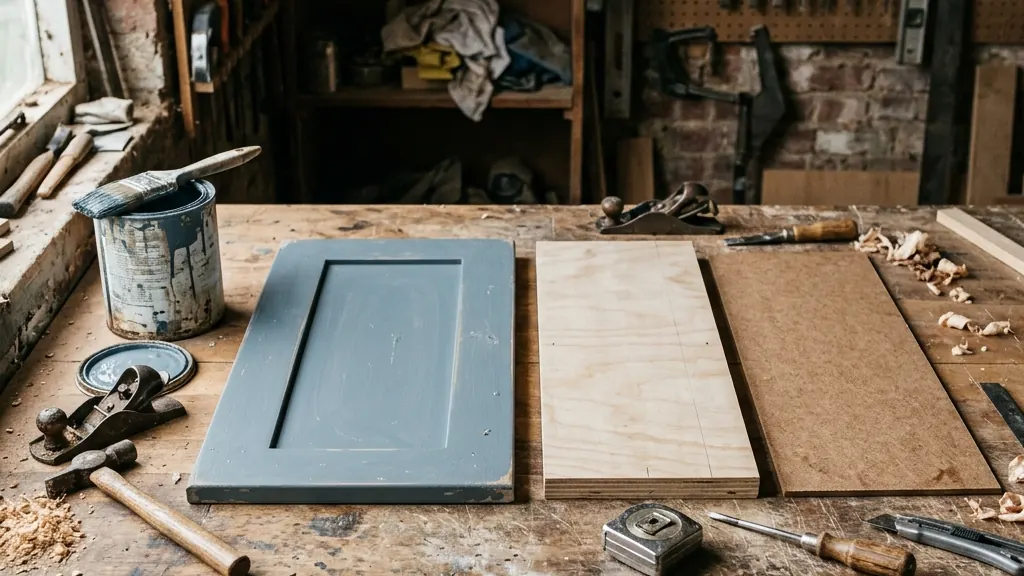
Work through this in order and you will not carry the wrong panel home.
- Name the job and the load. If the sheet carries weight, spans a gap or gets walked on, start with plywood and check the span rating.
- Check the moisture exposure. Wet zone, exterior or a room that gets humid means exterior-rated plywood or a moisture-resistant panel, never standard MDF.
- Decide the finish. A flat painted face points to MDF board. A structural face that stays visible points to a good plywood grade.
- Match the thickness to the hardware. Confirm the panel thickness your hinges, slides and fasteners are rated for, and check the spec sheet rather than guessing.
- Confirm the certification. Look for the structural stamp on plywood and the classification marking on MDF, and ask the yard if the stamp is missing.
- Plan the cuts and the edges. Seal exposed MDF edges, allow for plywood movement, and buy one spare sheet for the cuts you will get wrong.
- Store it flat and dry. Sheets left leaning against a wall or sitting on a damp floor will bow before you ever cut them.
Mistakes That Cost You a Sheet
Skipping the edge seal on MDF is the most common one. A painted MDF panel with a raw cut edge will show a raised line within a season.
Using standard MDF in a bathroom is the second. The moisture-resistant grade exists for a reason, and even that grade is not a wet-area material.
Assuming all plywood is structural is the third. Only a stamped sheet is graded for load, and a utility-grade panel from the bargain pile is not the same product.
Over-tightening screws in MDF edges is the fourth. Predrill, use the right screw, and stop when the head seats.
Buying fiberboard for a frame is the fifth. It is a panel material, and a frame built from it will not hold.
When to Call a Pro
Call a structural engineer or your local building inspector when the sheet is part of a load path, a floor, a roof or a wall that has to pass inspection. That is not a DIY call, and no blog post substitutes for the stamped plan.
Call a cabinetmaker when the project needs a veneered or profiled face and you do not have the press or the experience to lay veneer flat. Veneered MDF is unforgiving of a bad glue-up.
Call an electrician if the panel work touches wiring, boxes or anything inside a wall cavity. Cutting into a wall without knowing what is behind it is how people get hurt.
MDF vs Plywood vs Fiberboard FAQ
Is MDF stronger than plywood?
Plywood is stronger in bending and screw-holding, while MDF has a modulus of rupture of 40 MPa and works for supported shelving.
Can MDF board be used in a bathroom?
Standard MDF should stay out of bathrooms because it swells permanently when water reaches the core. Moisture-resistant MDF slows water uptake but is still not a wet-area material, so use exterior-rated plywood where water is likely.
What is high density fiberboard used for?
High density fiberboard goes where a thin, hard, flat panel has to resist wear, such as drawer runners, jig bases, router table tops and door skins. It is denser and heavier than standard MDF and harder on cutting tools.
Does plywood need a stamp to be structural?
Yes. Structural plywood in the United States is produced to Voluntary Product Standard PS 1-22.
How thick is concrete-forming plywood?
Concrete-forming plywood ranges from 15/64 to 13/16 inch (6 to 21 mm) thick. Confirm the thickness your formwork design calls for on the spec sheet before you buy.
Thank you for reading!