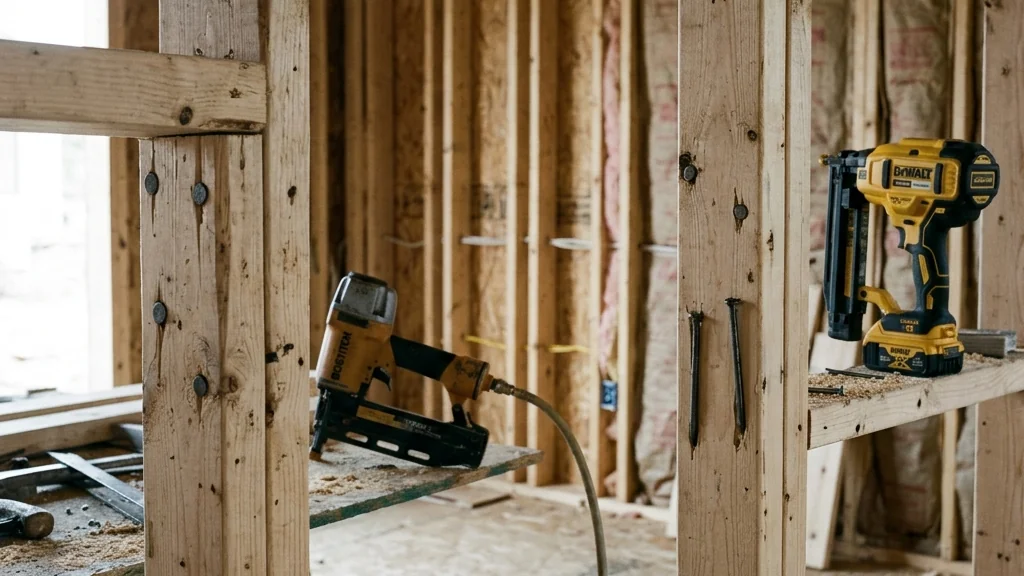
A pneumatic framing nailer needs a compressor and hose, and its separate compressor can make the tool lighter for overhead work. A cordless framing nailer costs more up front and carries a battery, yet it lets you walk a bare lot with no power and no hose drag.
Start With the Job, Not the Tool
The framing nail gun handles many of the fastener-driving tasks on a framing crew. Sheathing, studs, plates, blocking, trimmers — the tool that drives those fasteners decides how fast the walls go up and how tired you are at four in the afternoon.
The answers usually point one way. A remodeler hanging a few walls, rebuilding a garage, or fixing a deck frame needs a tool that starts on the first trigger pull wherever the truck is parked.
The first pneumatic nail gun was introduced in 1950 to speed floor sheathing construction. That history gives the air system a long record of use. Check local suppliers for compatible parts and nails. Pneumatic nailers remain common in construction, alongside Cordless Tools and Compressors.
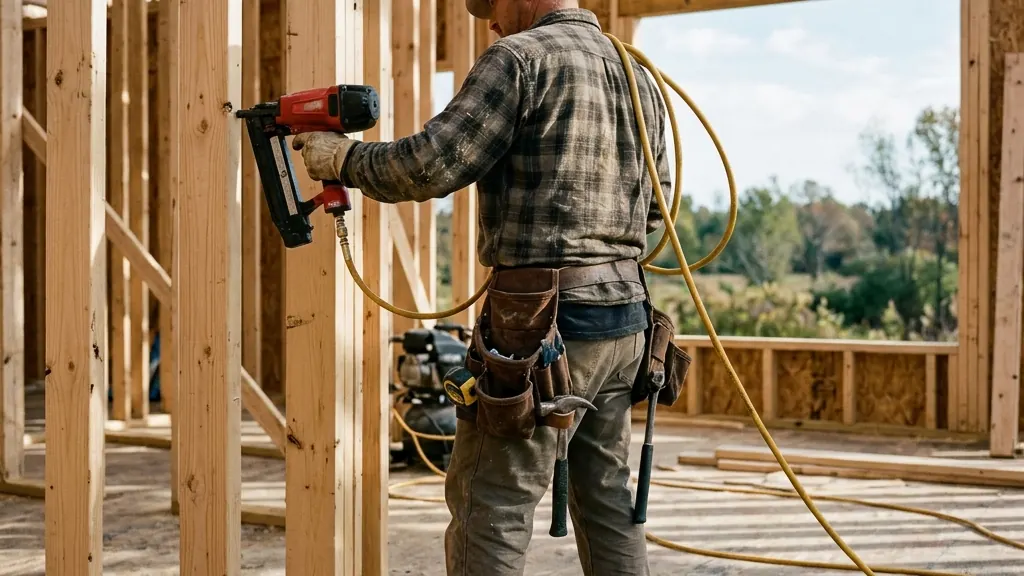
How a Pneumatic Framing Nailer Works and What It Costs to Run
A pneumatic nailer is a simple machine. Compressed air pushes a piston, the piston drives the fastener, and a return spring resets the tool.
The trade-off is the air system. You need a compressor sized for the tool, a hose long enough to reach the work, and fittings that do not leak.
The running cost is where air can look attractive. A pneumatic tool has no battery to buy, charge or replace, and some users find it costs less to operate over time, depending on the products compared.
Two practical habits keep an air gun reliable. Drain the compressor tank at the end of every day, because accumulated moisture can damage or impair air tools. And oil the tool as often as the manual says.
One more thing about capacity. Check the spec sheet for the exact count on any tool you buy, because a bigger magazine means fewer reloads on a long wall.
What a Cordless Framing Nailer Gives You
A cordless framing nailer runs on a battery and drives fasteners with either a flywheel or a gas cartridge, depending on the design. You pick it up, load a strip, and work. No hose to drag over sawhorses, no compressor to start, no extension cord to trip over.
That freedom is worth real money on certain jobs. A repair on a second-floor deck, a shed at the back of a lot with no outlet, a fence frame in a field — the cordless gun does all of it without a generator.
The costs are honest and predictable. And the tool is heavier in the hand, which you feel after an hour of nailing over your head.
Battery platforms matter here. If you already run a brand’s batteries for your drill and saw, buying the bare tool and sharing batteries is the cheapest route into cordless framing. If you are starting fresh, price the whole kit before you commit.
Cordless guns also need a little care in cold weather. Cold conditions can affect batteries; follow the manufacturer’s storage and operating guidance.
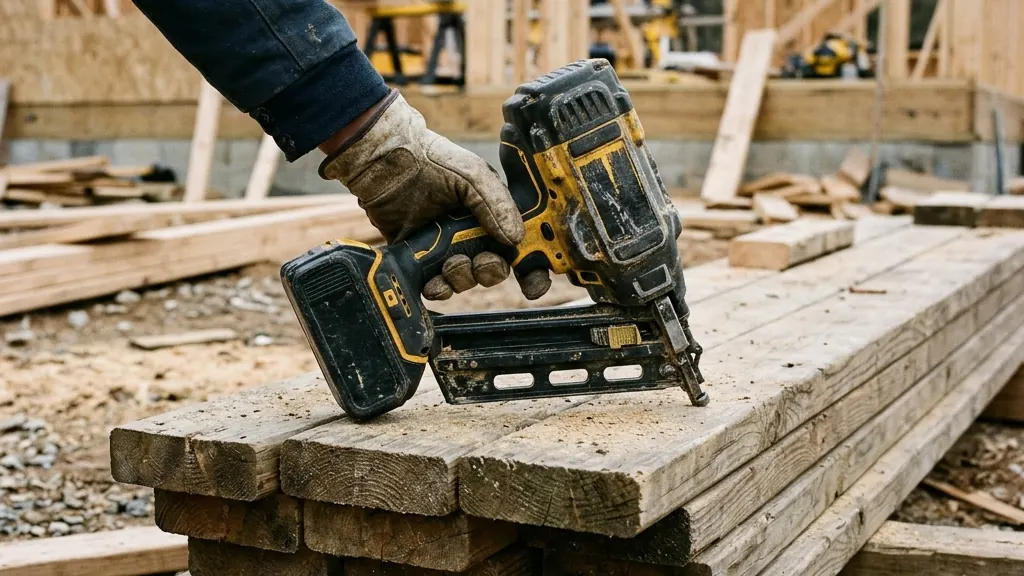
Setting Up Either Gun: The Procedure
Whichever you choose, the setup routine is the same in spirit. Prepare the tool, prepare the material, then work in a rhythm you can hold all day.
- Read the manual for the tool’s nail angle, nail length range and air or battery requirements, and check the spec sheet against the fasteners you plan to use.
- For air, set the compressor regulator to the tool’s rated pressure and drain the tank before you start.
- Load a full strip of framing nails, confirm the angle matches the magazine, and check that the follower is locked behind the nails.
- Set the depth adjustment on a scrap piece of the same lumber you will be nailing, then test-fire into the scrap until the heads sit just below the surface.
- Connect the air hose with the tool pointed away from you, or insert the battery with the trigger untouched.
- Work with a consistent stance, keep your free hand clear of the nail path, and reload before the magazine runs dry rather than mid-wall.
- At the end of the day, disconnect the air or pull the battery, clear the magazine, and wipe the tool down.
That depth-setting step is the one people skip, and it is the one that decides whether your sheathing sits flush or stands proud. Set it on scrap, every time you change lumber.
If you are cutting your own studs and plates on site, the blade you choose changes the cut quality more than most people expect, and our guide to kerf and blade width explains why. For tearing out old framing before you rebuild, the blade and technique advice in our reciprocating saw basics for demolition cuts will save you time.
Weight, Balance and Overhead Work
Framing is not all waist-high work. You nail headers, rim joists, blocking between studs, and sheathing over your head. Tool weight matters most in exactly those positions.
A cordless gun puts the battery and the drive mechanism in your hand. That weight is the price of freedom from the hose, and it is a fair price on short jobs. On a full day of overhead work it adds up.
Balance matters as much as raw weight. A gun that hangs level in your hand points where you look. A nose-heavy tool makes you fight the work piece on every shot. Handle both before you buy, ideally with a battery or hose attached.
A palm nailer is suited to tight work such as joist hangers, which is a different job from framing. Keep the right tool for the right fastener.
Safety: The Part Nobody Argues About
Nail guns are not toys, and the numbers back that up.
So here is the short list of rules I will not bend on. Never disable the contact safety. Never carry a connected gun with your finger on the trigger. Never point the tool at anything you are not willing to destroy. And never, ever try to clear a jam with the air connected or the battery in.
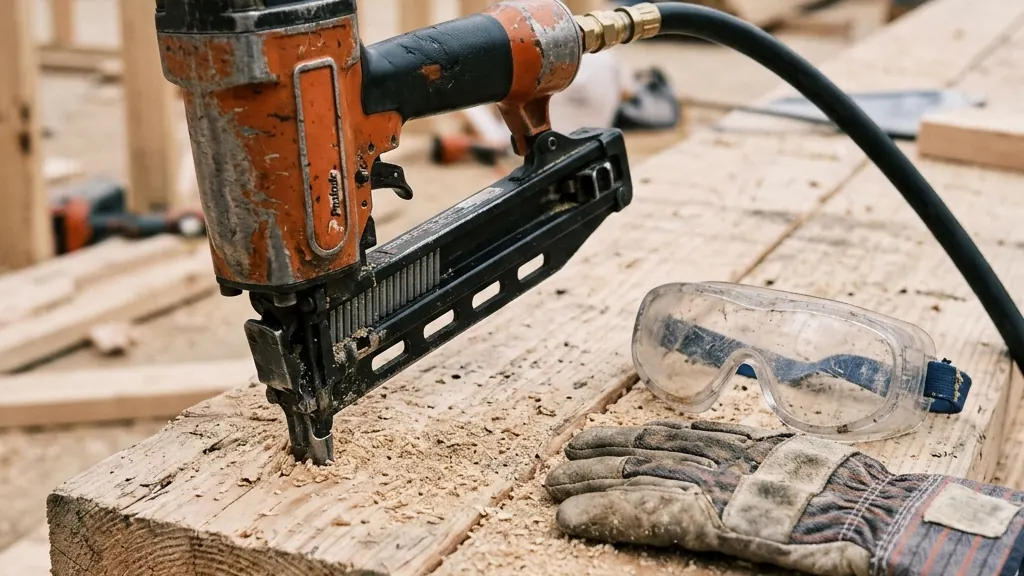
Eye protection is not optional. Framing nails can ricochet off a knot, and a strip can fire sideways if the magazine is worn. Wear glasses rated for impact, and wear them every shot.
When to Call a Pro or Rent Instead
Buying a framing nailer for one shed is a poor trade. Rent the tool for the weekend, or hire the framing out and keep your weekends.
Check local requirements and consult a qualified professional where required, especially for load-bearing or engineered work. A nail gun does not make you a framer, and a bad frame is expensive to fix.
Rent when the job is short and the tool is expensive. A rental yard may provide a pneumatic gun and a compressor for less than buying, depending on rental rates and duration, and you can try the weight and balance before you commit.
If you are cutting metal connectors, brackets or flashing on the same job, our guide to cutting metal with a circular saw covers the blade and safety setup that keeps that work clean.
For a homeowner building a deck frame or a shed, a cordless gun and a few boxes of nails is often the whole purchase. For anyone framing regularly, the air gun and a decent compressor can be a practical long-term setup.
Check parts, service, and warranty support before buying.
Framing Nailer FAQ
Do I need a compressor for a cordless framing nailer?
No. A cordless framing nailer runs on a battery, so it needs no compressor, hose or power outlet. You charge the batteries and work wherever the job is.
Which is cheaper to run, air or battery?
Air can cost less to run over time for some users, since a pneumatic tool has no batteries to replace. A cordless gun costs more up front and adds battery cost later.
Can a framing nailer drive nails into engineered lumber?
Check the spec sheet for the tool and the fastener before you try. Engineered lumber and some dense species need specific nails and sometimes a higher-pressure tool. Test on scrap first.
How many nails does a framing nailer hold?
Check the spec sheet for the exact count on your tool.
Is a palm nailer a substitute for a framing nailer?
No. It is a companion tool, not a replacement for a framing gun.
Thank you for reading!